
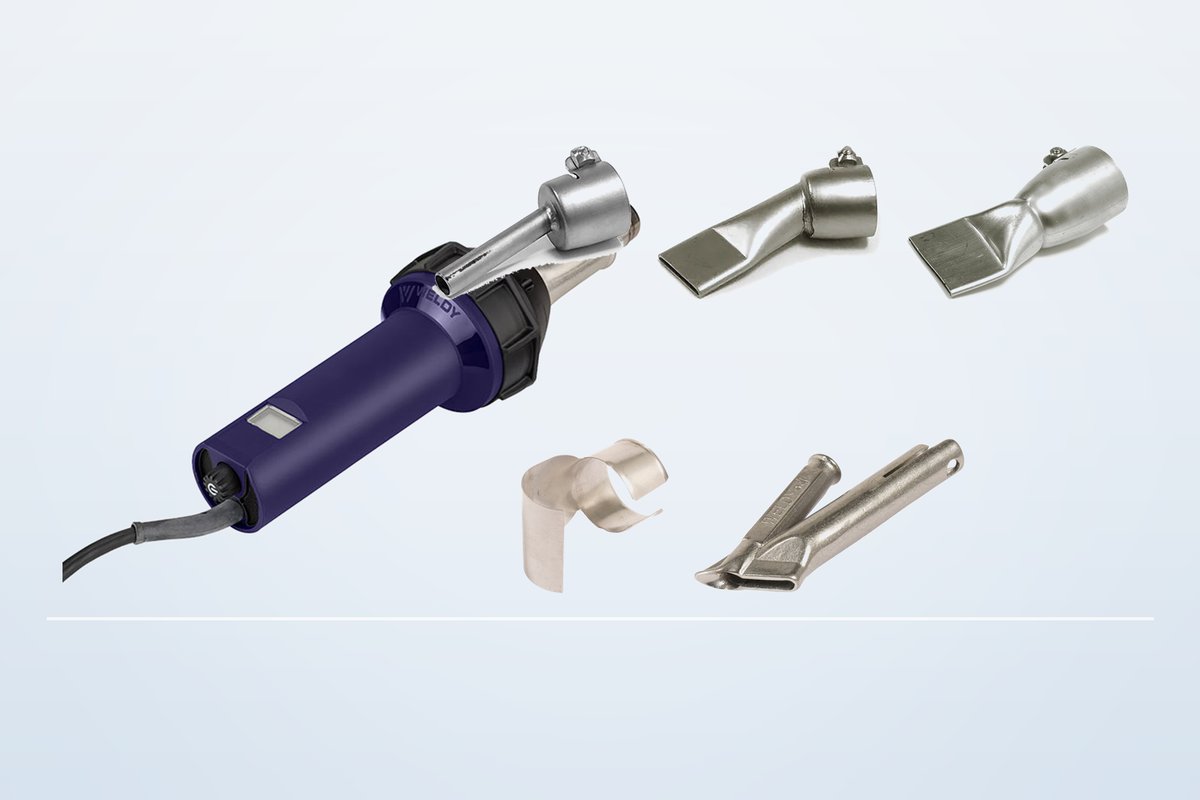
Most Weldy nozzle ordering mistakes are not about the slot size at all — they are about the connection diameter on the back of the nozzle. This guide sets out how the Energy HT1600, HT1600D and HT3400 differ at the nozzle interface, which of the nozzles we stock fits which gun, and where speed and tacking nozzles actually mount.
Start With the Connection Diameter, Not the Slot Size
A welding nozzle is specified by two separate things: the connection diameter that mounts on the tool, and the slot or pipe dimensions that shape the hot air stream. Buyers usually arrive knowing the second number. The first one decides whether the nozzle goes on the gun at all.
Every nozzle page we publish carries the connection diameter as its own line. It is 31.5 mm on the tubular nozzle, article no. 147.250, 35.5 mm on the 50 x 3 mm wide slot nozzle, and 50 mm on the spoon reflector. Match that number to the tool first; choose the slot you need second.
HT1600 and HT1600D: the 31.5 mm Connection

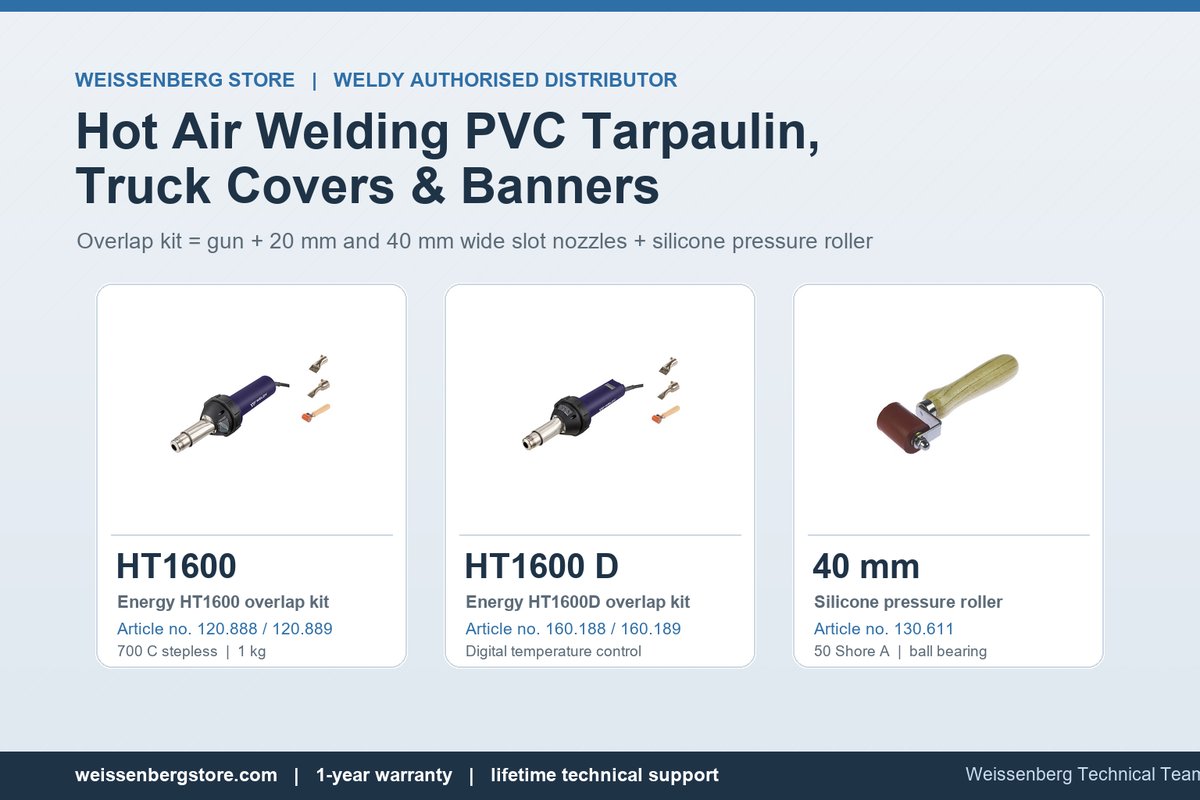
The Weldy Energy HT1600 and the Energy HT1600D share the same nozzle interface: 31.5 mm. The two guns differ elsewhere — the HT1600 runs stepless temperature control up to 700 °C, the HT1600D regulates digitally on an LCD between 40 and 620 °C with overheating protection and a cool-down function — but nozzle fit does not change between them: the direct-fit nozzles in the table below are officially listed as compatible with both guns.
| Nozzle | Article no. | Connection ø | Stated for |
|---|---|---|---|
| Tubular nozzle (ø 31.5) ø 5 mm, 37 mm | 147.250 | 31.5 mm | energy HT1600 / energy HT1600 D |
| Wide slot nozzle (ø 31.5) 20 x 2 mm | 124.772 | 31.5 mm | energy HT1600 / energy HT1600 D |
| Wide slot nozzle (ø 31.5) 40 x 2 mm | 124.777 | 31.5 mm | energy HT1600 / energy HT1600 D |
Where Speed and Tacking Nozzles Actually Mount
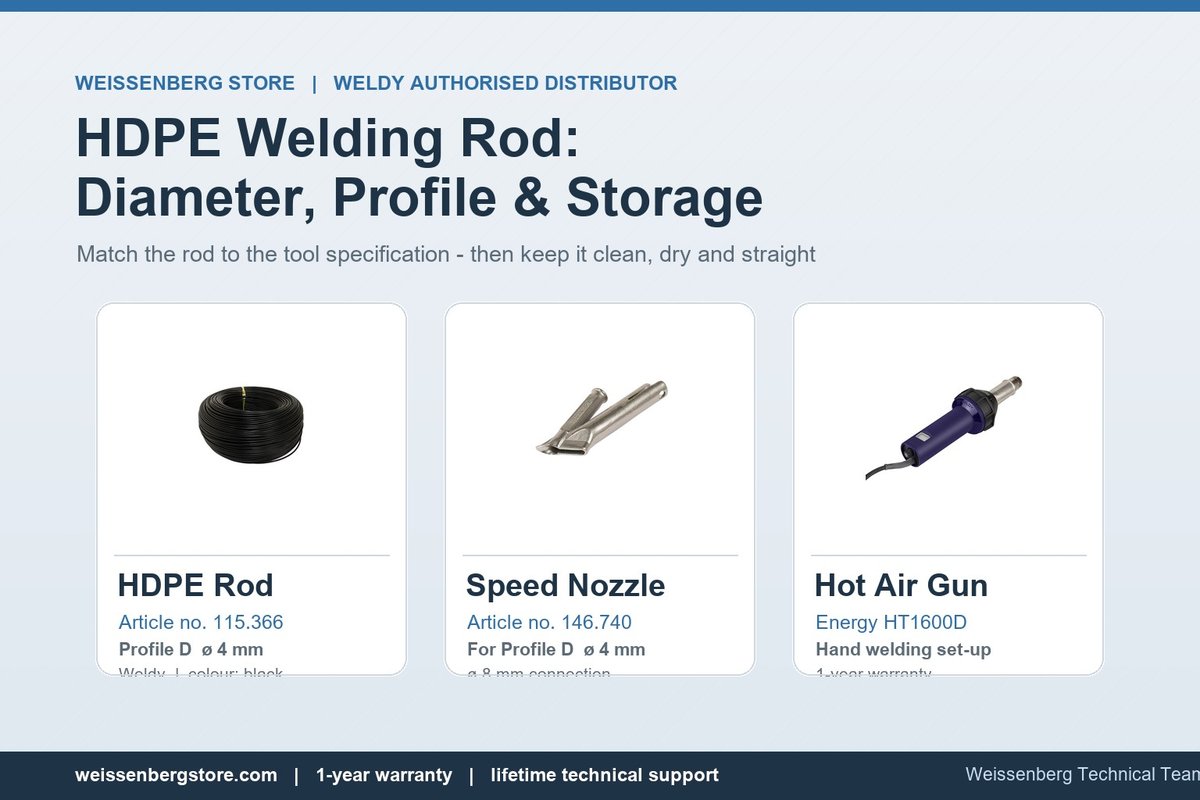
The speed welding nozzle (ø 8.0) Profile D ø 4, article no. 146.740, and its Profile D ø 5 counterpart, article no. 125.315, do not mount straight onto the gun. Both are specified to mount onto a standard 5 mm nozzle, regular or reinforced. The Tubular nozzle (ø 31.5) ø 5 mm, 37 mm, article no. 147.250, is the 5 mm tube nozzle on that connection, and it is the one that carries speed welding and tack welding nozzles — which is how the tacking nozzle (ø 8.0), article no. 147.248, goes on.
So speed-welding and tacking setups are a two-part order, not a one-part order: the 31.5 mm tubular nozzle on the gun, then the 8 mm speed or tacking nozzle on the tube. Ordering the speed nozzle alone is a common reason a genuinely compatible nozzle arrives and cannot be fitted.
The wide slot nozzles are not part of that stack: they are direct-fit. The 20 x 2 mm and 40 x 2 mm wide slot nozzles mount straight onto the gun's 31.5 mm connection and do not go through the tubular nozzle at all.

HT3400: the 50 mm Connection

The Weldy Energy HT3400 is a different interface: 50 mm. It is a higher-output tool — 3400 W, a stated airflow of 320 l/min and 40–650 °C — and it takes the larger work nozzles:
| Nozzle | Article no. | Connection ø | Stated for |
|---|---|---|---|
| Wide slot nozzle (ø 50.0) 70 x 10 mm | 130.650 | 50 mm | energy HT3400 |
| Spoon reflector (ø 50.0) 60 x 55 mm | 130.633 | 50 mm | energy HT3400 |
A common mistake here: a 31.5 mm nozzle will not fit an HT3400, and a 50 mm nozzle will not fit an HT1600 or HT1600D. Where both guns are in use in one shop, keep the two nozzle sets separate — the connection sizes are far enough apart that a mismatched nozzle simply will not seat.
The 35.5 mm Nozzles Belong to a Different Gun Family
There is a third connection size in the range, and it is a common mix-up. The Wide slot nozzle (ø 35.5) 50 x 3 mm, article no. 119.342, is made for tools with a 35.5 mm connection; Weldy currently lists the HG 330-A as compatible. It is not part of the Energy HT1600 / HT1600D / HT3400 fit. The 35.5 mm figure in its name is the connection diameter, not the slot; the slot is the 50 x 3 mm pair. Reading “50 mm” as the fit is how this nozzle ends up ordered for the wrong gun.
Choosing the Slot and the Filler for the Job
Once the connection is right, two things still have to agree with the work: the slot or pipe dimensions, and — for filler work — the rod the nozzle is specified for. The 146.740 nozzle is specified for Profile D ø 4 rod and the 125.315 for Profile D ø 5; take those from the nozzle page or the tool specification rather than from the part in front of you. For a direct comparison of the two rod sizes, see our 4 mm vs 5 mm speed welding nozzle guide. For how speed, wide slot and tubular nozzles differ in use, the plastic welding nozzle guide and the wide slot nozzle size comparison cover the alternatives.
Then set the job up on offcuts rather than on the work. Heat, travel speed and pressure all matter together: the aim is to bring the joint and the filler to the point where they merge while the heated surfaces remain properly plasticized, and to keep the pressure even along the weld zone as the seam consolidates. Evaluate a trial weld on the actual material against the material manufacturer’s instructions, the welding procedure specification for the job and the project’s acceptance criteria before starting production seams.
Possible Causes: A Nozzle That Will Not Fit, or a Weld That Looks Wrong
| Observation | Possible causes | Where to check |
|---|---|---|
| Nozzle will not seat on the gun | Connection diameter not matching the tool; wrong nozzle for the gun family; debris on the collar or seating face | Connection ø on the nozzle page against the tool specification; seating face |
| Speed welding nozzle will not mount | 5 mm tubular nozzle not fitted first; nozzle ordered for the other rod profile | Tubular nozzle 147.250 in place; rod profile stated on the nozzle |
| Nozzle fits but wobbles or leaks air | Nozzle not pushed fully home; damaged or deformed connection collar | Seating depth; condition of the nozzle collar and the gun outlet |
| Airflow weaker than expected | Slot partly blocked; resin or debris build-up; nozzle size not matched to the work | Slot and channel cleanliness; the nozzle specified for the task |
| Narrow or uneven weld band | Nozzle not held consistently to the joint; travel speed; uneven pressure | Technique and hand speed; trial weld on offcuts |
| Bead does not merge with the sheet | Rod profile or material not matching the nozzle and the parts; heat and travel speed; seam not consolidated while the surfaces were still plasticized; pressure not even along the seam | Rod data against the nozzle specification; material manufacturer’s data and the job WPS; trial weld |
| Discolouration, bubbles or voids | Contamination on nozzle, rod or sheet; heat input; travel speed not suited to the material | Cleanliness of nozzle and work; temperature setting; travel speed |
Nozzle fit and weld quality overlap, so work through the possibilities rather than changing everything at once: change one variable, re-test on offcuts, and compare. It is unusual for a single part to be the only cause. Nozzles also need looking after — inspect and clean before use and as needed, because build-up in the slot or channel changes how the air leaves the tool.
Ordering the Right Weldy Nozzle
If you are running an HT1600 or HT1600D, start from the 31.5 mm tubular nozzle and add the Profile D ø 4 or Profile D ø 5 speed nozzle for rod work, or, for overlap seams instead, the direct-fit 31.5 mm wide slot nozzle that mounts straight on the gun. On an HT3400, the 50 mm spoon reflector is the matching nozzle we stock. The Energy kit selection guide covers which gun and kit suit which job.
Unsure which nozzle your tool takes? Send us the gun model and the work you are doing and we will confirm the connection diameter, the nozzle and the rod together. Every item ships from the Accessories and Hot Air Gun ranges with a 1-year warranty and lifetime technical support.




Leave a comment
This site is protected by hCaptcha and the hCaptcha Privacy Policy and Terms of Service apply.