
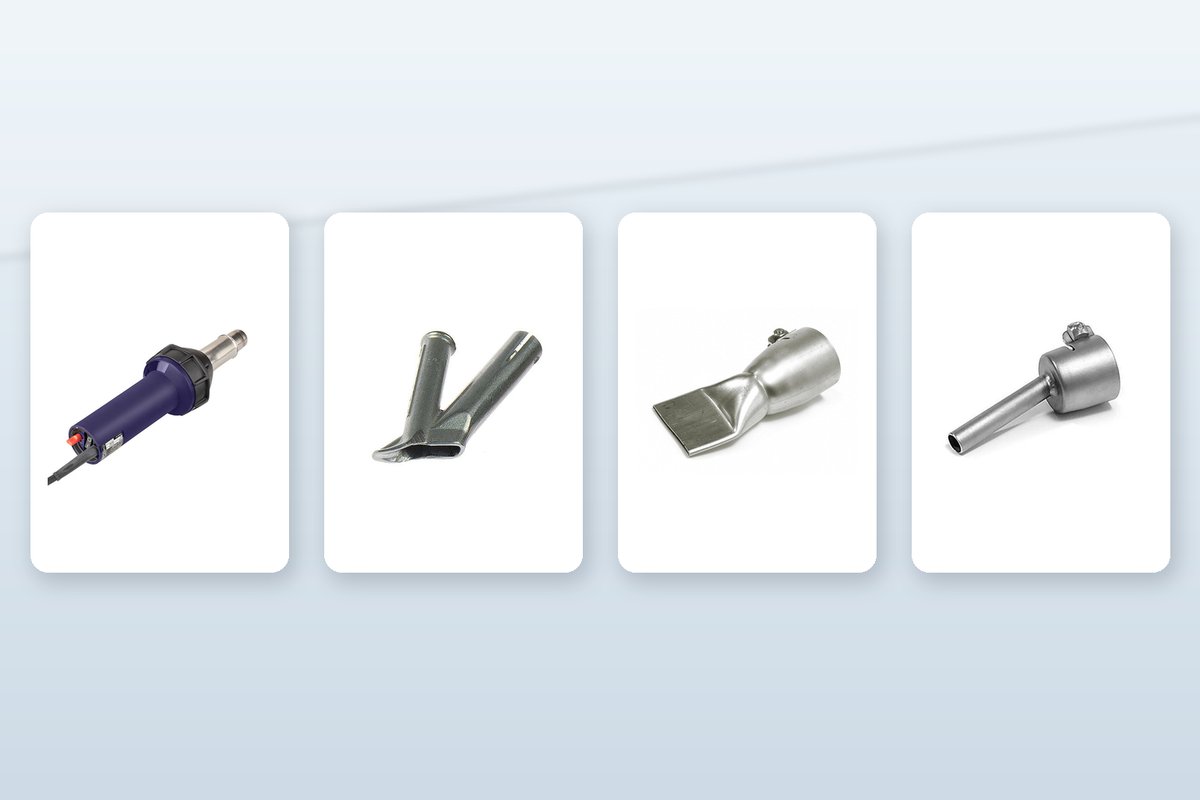
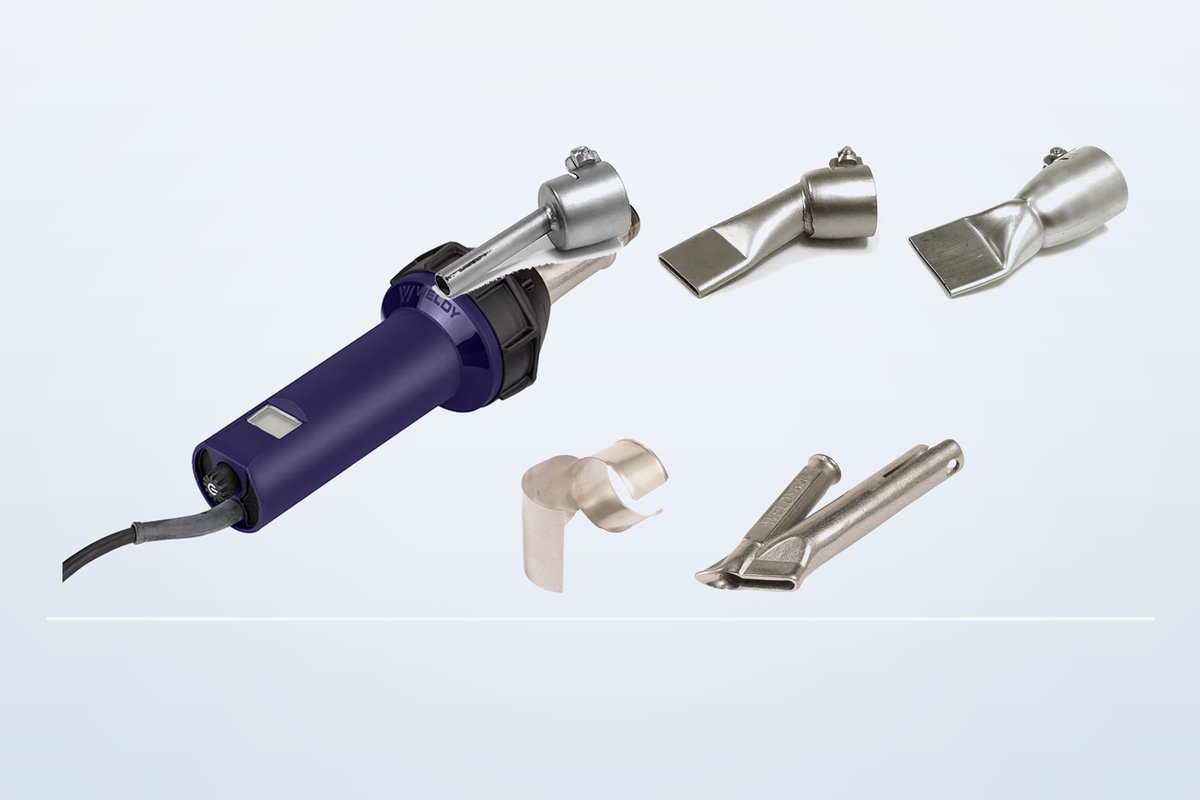
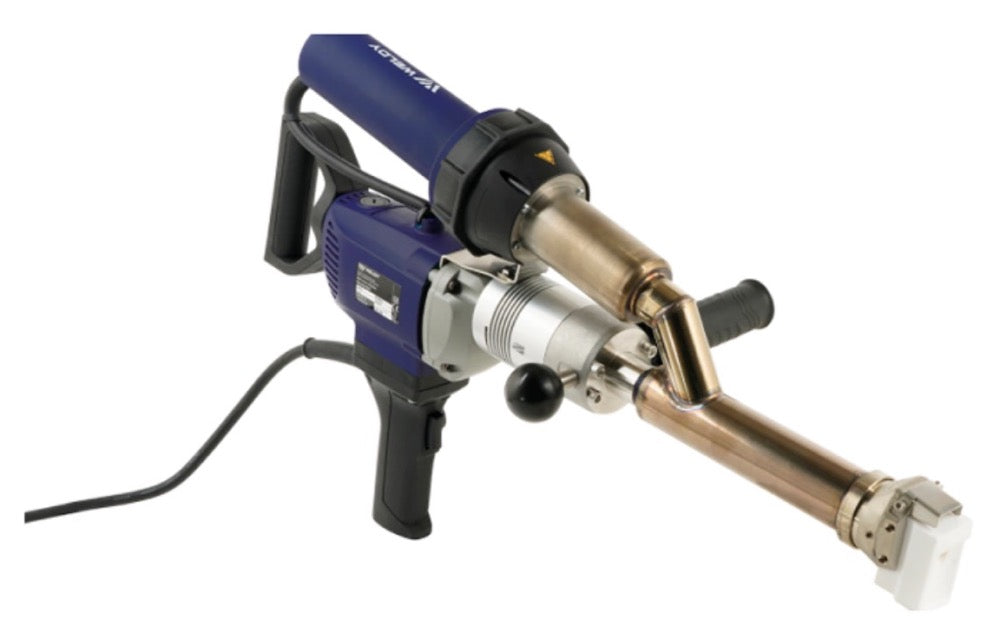
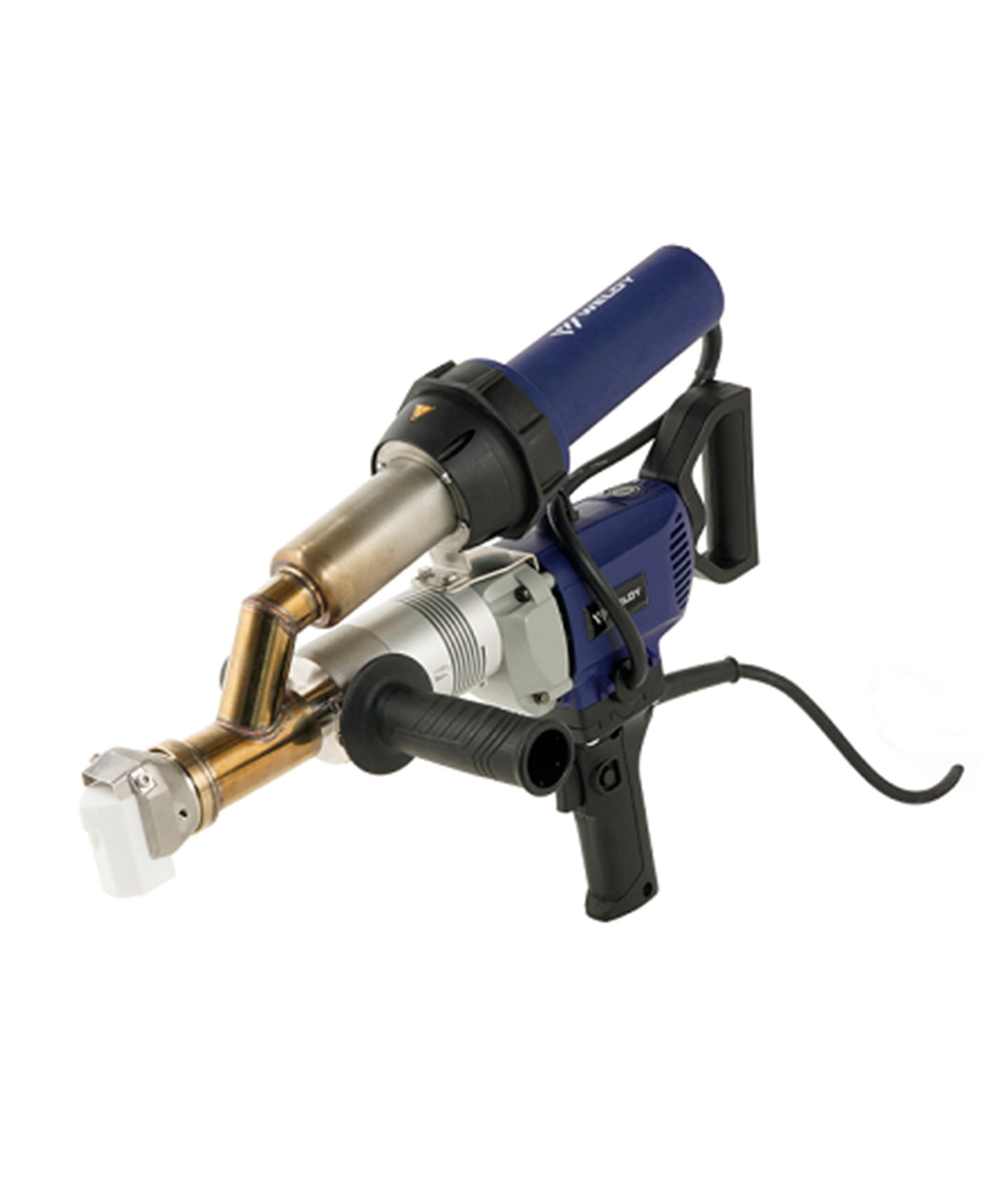
Every hot-air hand weld starts with the same decision: which plastic welding nozzle goes on the gun. The nozzle shapes the air stream, the heat pattern and the joint geometry, so swapping it is the fastest way to change weld quality on a jobsite. In this guide, the Weissenberg Technical Team — 19+ years in plastic fabrication — compares the three nozzle families sold in our accessories range: speed welding nozzles, wide slot nozzles and tubular nozzles, plus the tacking nozzle that supports them.
Speed welding nozzles: rod-fed seams in one pass
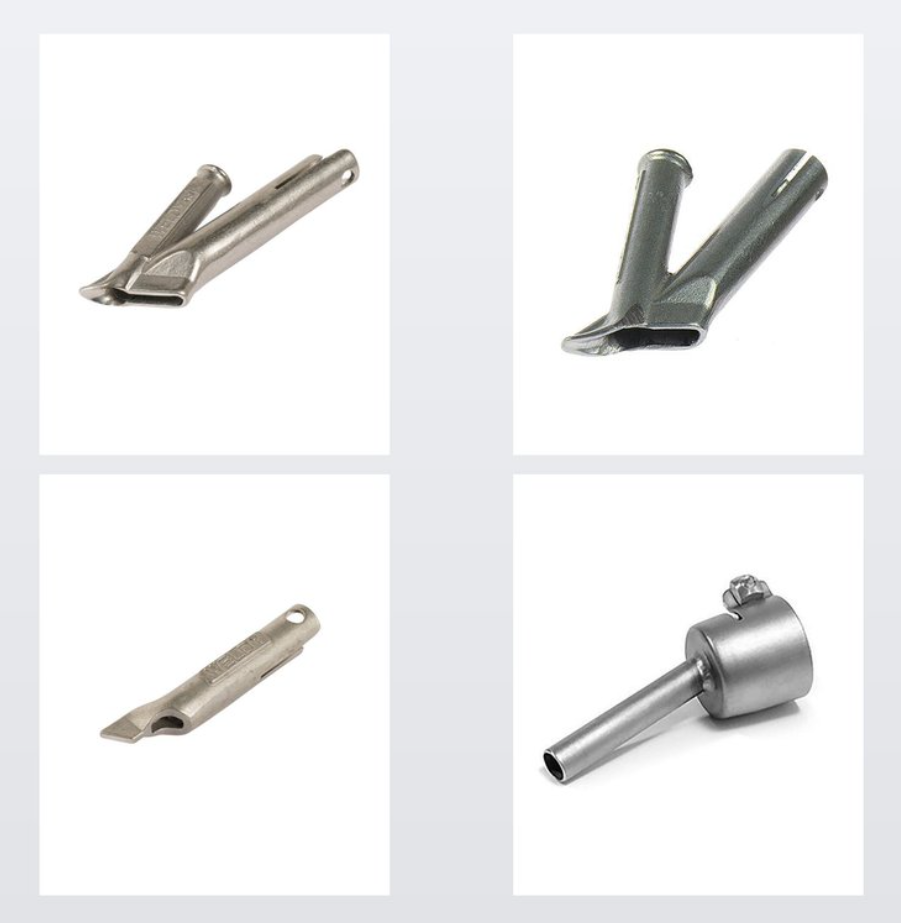
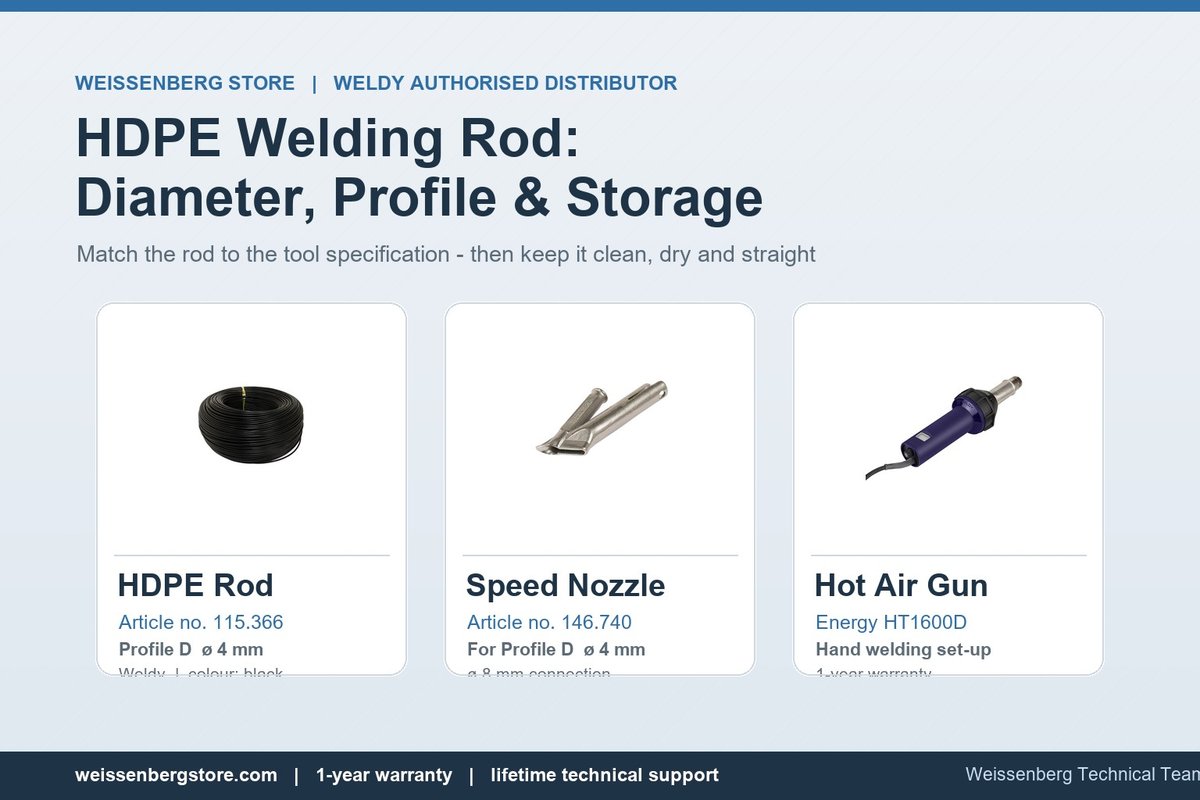
A speed (or quick) welding nozzle guides the welding rod directly into the joint while a focused air stream heats the groove walls and rod together. It is the workhorse for fillet and V-groove welds with filler rod on HDPE and PP sheet — tank corners, ducting, pipe saddles and plastic flooring. The nozzle carries an Ø 8.0 mm push-fit collar that slides over the gun's standard 5 mm tubular nozzle (Ø 31.5 mm gun connection), so it works with Energy 1600, HT1600 and HT1600D class tools.
Match the nozzle to the rod diameter: the Profile D Ø 4 speed welding nozzle (146.740) pairs with 4 mm rod, while the Profile D Ø 5 speed welding nozzle (125.315) takes 5 mm rod for heavier seams. Welding a 4 mm rod through a 5 mm nozzle starves the weld; welding 5 mm rod through a 4 mm nozzle overloads it.

Tip: on a test weld the rod should flow into the groove with a glossy, uniform surface. Dull or grainy beads mean the air temperature is too low or the travel speed too fast.
Wide slot nozzles: a flat stream for overlap seams
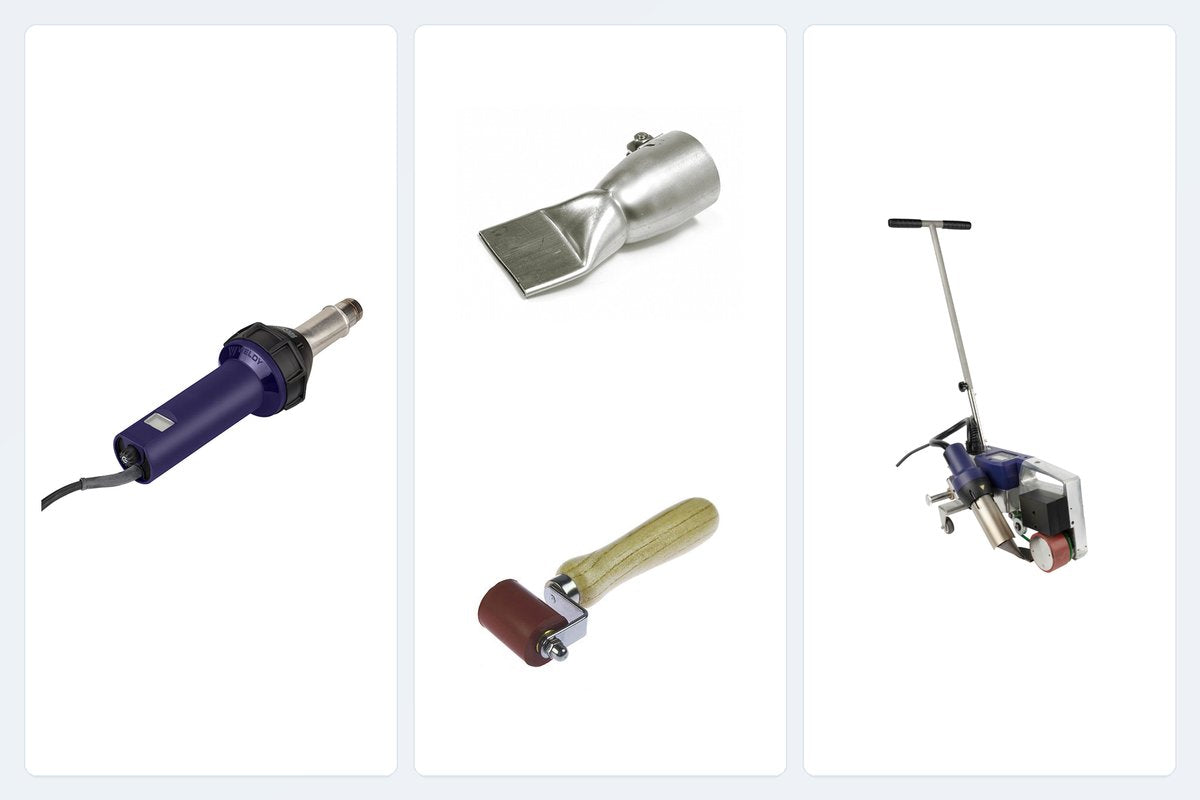
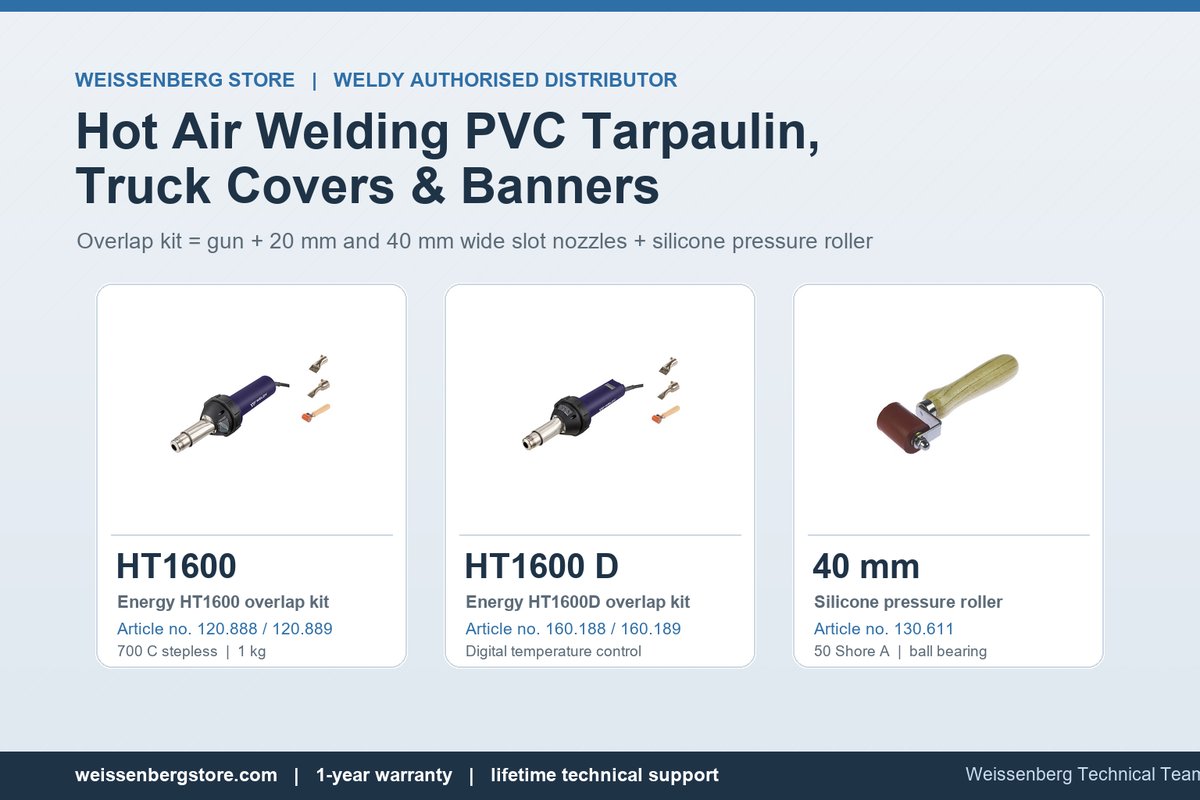
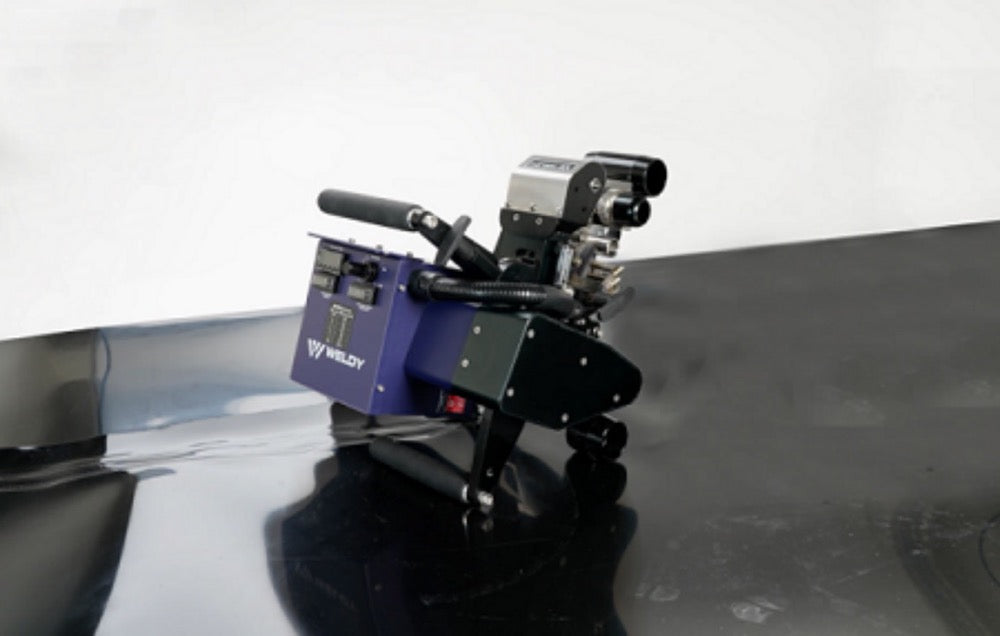
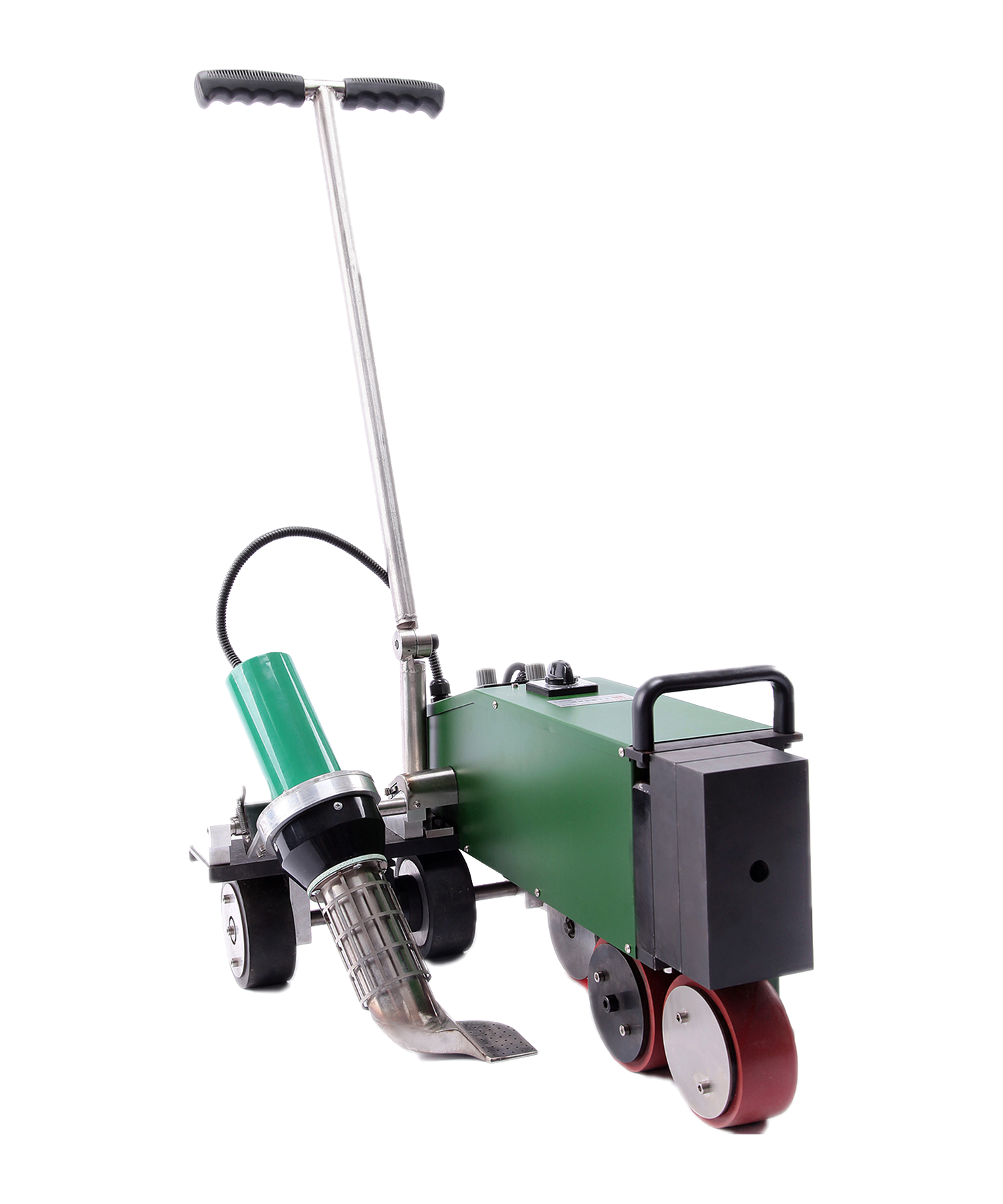
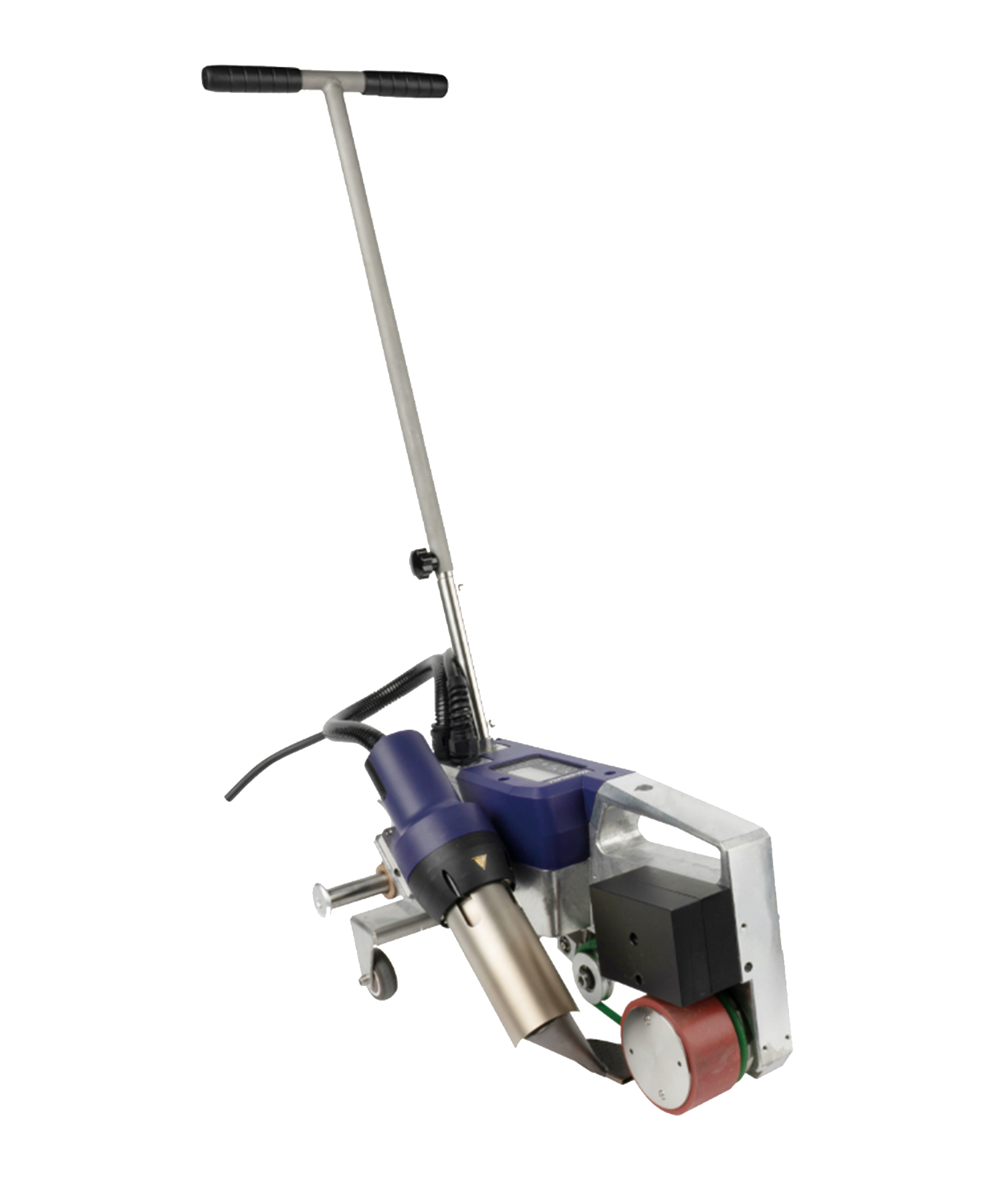
A wide slot nozzle discharges a wide, flat air curtain that heats both sheets of an overlap seam evenly. It is the correct choice for welding roll and sheet materials edge-over-edge: PVC tarpaulins and truck covers, banners, technical fabrics, TPO/PVC membranes, geomembranes and waterproofing films. After heating, a silicone pressure roller consolidates the seam while the material is still above softening temperature.
Slot size follows seam width. The reinforced wide slot nozzle 40 × 2 mm (124.777) with its Ø 31.5 mm gun connection suits Energy 1600 / HT1600 / HT1600D guns and covers most membrane work; a 20 × 2 mm version suits narrow laps and detail strips. For the higher-output 3400 W class (Weldy HT3400), step up to the wide slot nozzle 70 × 10 mm (Weldy art. 130.650), which uses the gun's larger Ø 50.0 mm connection and delivers a wider heated band for long production runs — contact our team if you need it added to your order.

Tip: keep the nozzle parallel to the seam and let the roller follow immediately behind the hot zone — a cold gap between heating and pressing is the classic cause of "zipper" failures in overlap welds.
Tubular nozzles: the versatile foundation
The round tubular nozzle is the most universal accessory in the system. Fitted directly on the gun's Ø 31.5 mm seat, the 5 mm × 37 mm pipe (147.250) delivers a concentrated round stream for pendulum (oscillating) welding, preheating, edge bending and heat shrinking — and it is also the mounting base that the Ø 8.0 speed and tacking nozzles slide onto. For fabricators who switch between rod welding and heating tasks, this one nozzle keeps the gun usable in both roles.
Tacking nozzles: position first, then weld
Tacking nozzles concentrate heat on a small spot so the operator can tack-weld parts in position before running the final seam. Tack spacing is not a fixed rule — it is project-dependent and should follow the relevant welding procedure specification (WPS); correct spacing keeps sheet edges aligned, gaps closed and thermal distortion low. The tacking nozzle (147.248) suits PP, PE, PVC, PC and ABS and is the correct partner for speed-nozzle work on tanks, housings and free-standing 90° joints.
Gun-to-nozzle compatibility at a glance
Two connection standards matter when ordering: the gun connection (the seat on the tool itself, Ø 31.5 mm or Ø 50.0 mm) and the Ø 8.0 mm push-fit collar used by speed and tacking nozzles, which slide over the 5 mm tubular nozzle already mounted on the gun seat.
| Gun | Connection | Nozzle | Part Number | Application |
|---|---|---|---|---|
| Energy 1600 / HT1600 / HT1600D | Ø 31.5 mm | Tubular (5 mm × 37 mm) | 147.250 | Pendulum welding, preheating, bending — and the base for push-fit nozzles |
| Energy 1600 / HT1600 / HT1600D | Ø 8.0 mm push-fit (over 5 mm tubular) | Speed welding nozzle, Profile D | 146.740 (Ø 4 rod) / 125.315 (Ø 5 rod) | Fillet & V-groove rod welding on HDPE/PP |
| Energy 1600 / HT1600 / HT1600D | Ø 8.0 mm push-fit (over 5 mm tubular) | Tacking nozzle | 147.248 | Spot tacking to hold parts in position |
| Energy 1600 / HT1600 / HT1600D | Ø 31.5 mm | Wide slot 20 × 2 mm / 40 × 2 mm | 124.772 / 124.777 | Overlap seams on tarpaulins, PVC/TPO membranes & films |
| Weldy HT3400 (3400 W class) | Ø 50.0 mm | Wide slot 70 × 10 mm (Weldy art. 130.650 — on request) | 130.650 | High-output, long production overlap runs |
Quick selection checklist
- Welding filler rod into a groove → speed nozzle matching the rod (Ø 4 or Ø 5), tacked first.
- Overlap seam on membrane, film or fabric → wide slot nozzle sized to the lap, pressed with a silicone roller.
- Preheating, bending, shrinking or nozzle switching → 5 mm tubular nozzle on the gun seat.
- Free-standing or butt joints → tack with the tacking nozzle before the main pass.
- Check your gun's connection before ordering: Ø 31.5 mm gun seat for Energy 1600 / HT1600 / HT1600D class tools, Ø 50.0 mm for the HT3400 (3400 W) class — and remember that speed and tacking nozzles use an Ø 8.0 mm push-fit collar over the 5 mm tubular nozzle, not a direct gun seat.
All genuine Weldy nozzles at the Weissenberg Store ship from our factory-direct stock and are backed by our 1-year warranty and lifetime technical support. Browse the complete plastic welding accessories collection or the hot air gun range to build a kit matched to your work — and contact our online service team if you are unsure which nozzle fits your gun.





Leave a comment
This site is protected by hCaptcha and the hCaptcha Privacy Policy and Terms of Service apply.