
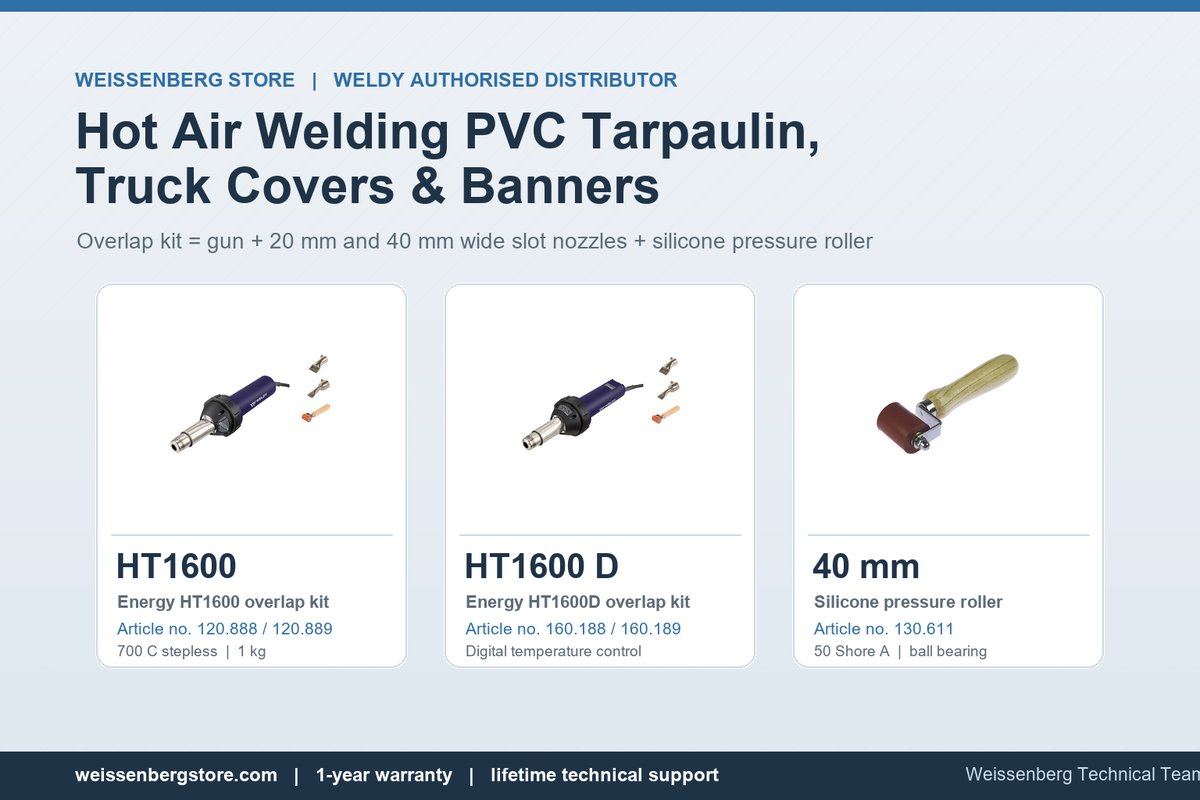
PVC tarpaulin welding with hot air joins vinyl-coated fabric by heating two overlapped surfaces until the coating is properly plasticized, then pressing them together while they are still soft. It is the everyday shop and site method for truck side curtains, tarpaulins and industrial covers, tent walls and printed banners. Here is what changes between those jobs, and how to set the gun up so the seam holds.
This guide applies to hot-air-weldable PVC-coated technical textiles. Always confirm the coating, print or surface treatment is specified as weldable by the fabric supplier.
Tarpaulins, Truck Covers and Banners: What Actually Changes
- Truck side curtains and flatbed covers — heavier coated polyester, long straight seams welded flat on a table before the curtain is hung. Keeping a long run straight is the challenge.
- Tarpaulins and industrial covers — the same material family, different problem spots: hems, eyelet patches, rope-reinforced edges and corners, where the roller has to reach tight geometry.
- Banners and advertising textiles — lighter PVC with a printed face, where heat management matters as much as seam strength. Plan the hem so the weld zone falls clear of the graphic.
All three use the same basic overlap hot-air welding principle: the coating is fused across an overlap, so the joint is a continuous welded seam rather than a perforated sewn line. The seam strength, appearance and weather resistance the finished joint has to meet depend on the fabric supplier’s instructions and the project specification.
Choosing the Gun, Nozzle and Roller
Weldy offers two 1,600 W Energy-series overlap welding kits: the energy HT1600 and the digitally controlled energy HT1600D. They share the same overlap-welding accessories, while the gun controls and airflow adjustment differ. Weissenberg Store stocks both.
| Specified item | energy HT1600 overlap kit | energy HT1600D overlap kit |
|---|---|---|
| Power | 1,600 W | 1,600 W |
| Available voltage variants | 120 V or 230 V, 50/60 Hz — select the correct version for your power supply | 120 V or 230 V, 50/60 Hz — select the correct version for your power supply |
| Temperature control | Stepless, 40–700 °C | Digital on LCD, 40–620 °C |
| Airflow | 240 l/min at 20 °C | 120–240 l/min, adjustable |
| Nozzle connection ø | 31.5 mm | 31.5 mm |
| Length | 346 mm | 360 mm |
| Weight | 0.99 kg | 1.2 kg |
| Supplied nozzles | Wide slot 40 × 2 mm (124.777) + 20 × 2 mm (124.772) | Wide slot 40 × 2 mm (124.777) + 20 × 2 mm (124.772) |
| Supplied roller / spares | Silicone 40 mm (130.611), blower brushes (125.810) | Silicone 40 mm (130.611), blower brushes (125.810) |
These are separate voltage variants, not a switchable dual-voltage tool.
The key specified differences between the two guns are the temperature control and the airflow: the energy HT1600 uses a stepless analog temperature control without a display, with a fixed 240 l/min airflow; the energy HT1600D provides a digital setpoint, with 120–240 l/min adjustable airflow. The digital display makes it easier to return to a documented numeric temperature setting, and adjustable airflow gives the operator another process variable to control. Both guns use the same Ø 31.5 mm nozzle connection, and the two overlap kits share the same 20 × 2 mm and 40 × 2 mm wide-slot nozzles and 40 mm silicone pressure roller.
Nozzles: direct-fit on the 31.5 mm connection
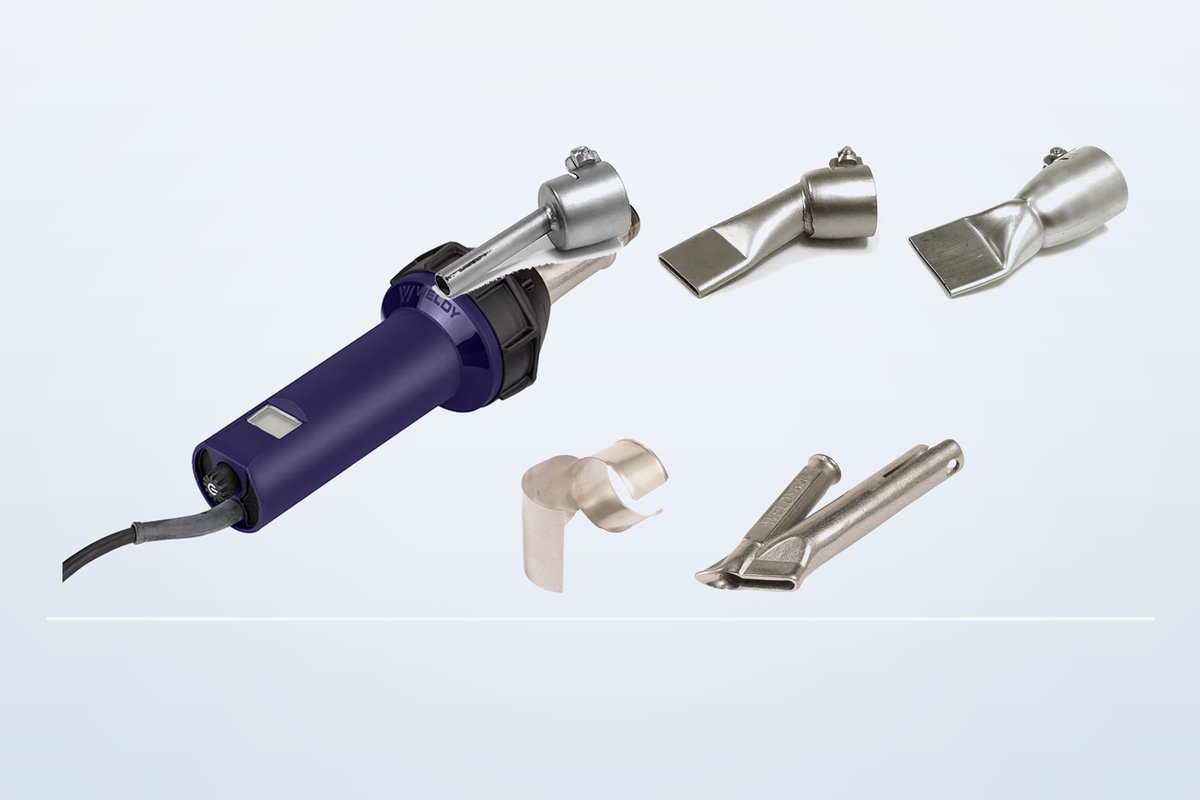
Both nozzles in the kits are direct-fit — they mount straight onto the gun’s 31.5 mm connection with no adapter. That is worth stating plainly, because it is not true of every nozzle type. Speed and tacking nozzles use a two-part setup: a Ø 31.5 mm tubular nozzle mounts on the gun first, and the Ø 8 mm push-fit speed or tacking nozzle mounts onto that tubular nozzle. The 40 × 2 mm nozzle (124.777) covers long straight seams; the 20 × 2 mm nozzle (124.772) reaches edges and corners where a wide head will not seat flat. The wide slot nozzle size comparison covers the ranges we stock.

Roller: match it to the seam you are closing
The silicone pressure roller is what turns plasticized coating into a fused seam. We stock 40 mm (130.611) and 30 mm (130.146); both share the same silicone body and ball bearing, and the key specified difference is the working width. Compare them in the 30 mm vs 40 mm pressure roller guide.

Safety note: When hot-air welding PVC-coated materials, work in a well-ventilated area, avoid overheating or burning the coating, and follow the material supplier’s safety data sheet (SDS) and workplace safety requirements.
Preparing a PVC Tarpaulin Seam, Step by Step
- Clean both surfaces. Clear dust, oil, moisture and plasticizer bloom from the weld zone. Contamination is the quietest cause of a weak seam, because the weld still looks complete.
- Work flat and taut. Lay the fabric on a flat, stable surface, hold it with tape or weights, and mark the weld line. Wrinkles roll into the seam and stay there.
- Set the overlap from the fabric supplier’s data and the project specification.
- Trial weld offcuts from the same roll, let the test cool fully, then assess it against the fabric supplier’s instructions and the project acceptance criteria.
- Weld. Bring the gun to temperature, insert the wide slot nozzle between the layers so hot air reaches both surfaces, and travel steadily with the nozzle parallel to the surface — the aim is to keep the heated surfaces properly plasticized along the whole seam.
- Roll immediately behind the nozzle with even pressure along the weld zone, then let the seam cool undisturbed before folding or stacking.
Heat, Travel Speed and Pressure Work Together
Temperature, travel speed, airflow and roller pressure work together. Moving too quickly can leave the coating insufficiently heated, while excessive dwell or temperature can overheat or discolour it. Insufficient pressure may prevent full consolidation, while excessive pressure can displace softened coating. Establish the starting setup with a trial weld, then adjust one variable at a time.
Possible Causes When a PVC Tarpaulin Seam Looks Wrong
Seam faults rarely have a single cause, and none of them belongs to one accessory alone.
| What you see | Possible causes | Where to check |
|---|---|---|
| Seam opens under load | Travel speed, temperature setting, roller pressure, surface contamination, or overlap too small | Trial weld from the same roll, the fabric supplier’s welding instructions, the project acceptance criteria |
| Glossy, discoloured or brittle weld line | Temperature too high for the material and coating, travel speed too slow, nozzle held too close, or dwell at the start | Temperature setting, travel habit, nozzle position at start and stop |
| Bubbles or a lifted weld line | Moisture or solvent on the surface, uneven roller pressure, or fabric not lying flat | Cleaning step, fabric tension, support table, roller technique |
| Coating sticks to the nozzle | Nozzle too close, temperature too high, or the gun held stationary in one spot | Nozzle clearance, temperature setting, whether travel is continuous |
| Print damaged on a banner | Weld zone planned over the graphic, heat spilling past the seam, or wrong nozzle width for the hem | Hem layout, nozzle slot width, position of the overlap on the panel |
| Failure around a patch or corner | Overlap too small, roller unable to seat flat, or pressure lost in tight geometry | Overlap layout, whether the 20 mm nozzle is needed, roller access |
Looking After the Gun and the Accessories
Inspect and clean the gun and accessories before use and as needed. Keep the nozzle slot clear of burnt coating — a partly blocked slot spreads heat unevenly and shows up as a patchy weld. Check the blower motor carbon brushes for wear; the kit variants referenced here include a spare set (125.810). Store the silicone roller clean and out of direct sun.

The Shortest Route to a Working PVC Tarpaulin Setup
Sourcing the gun, the nozzles, the roller and the brushes as separate items means matching every connection yourself. The energy HT1600 overlap welding kit and the energy HT1600D overlap welding kit arrive matched: 1,600 W tool, 40 × 2 mm and 20 × 2 mm wide slot nozzles, a 40 mm silicone pressure roller, spare carbon brushes and instructions in a case. Choose 120 V or 230 V for your supply; the Energy kit selection guide covers HDPE and PP work too.
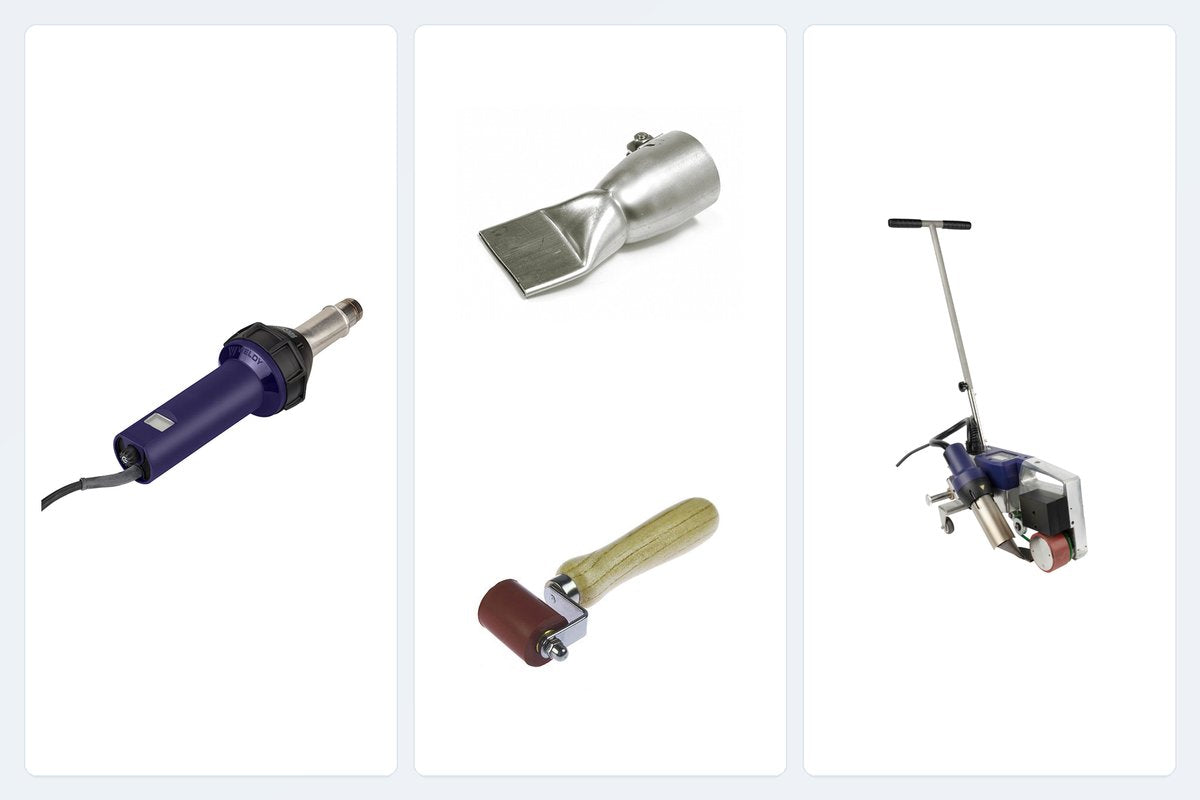
Already own the gun? The 40 × 2 mm wide slot nozzle, the 20 × 2 mm wide slot nozzle and the 40 mm silicone pressure roller are available on their own, alongside everything else in the Hot Air Gun and Accessories collections. Weissenberg Store is an authorised Weldy distributor and also manufactures the RYG, RYH, RYA, CONDOR, HAWK and GOPHER lines — send us the fabric type and the seam you need, and our technical team will point you at the right setup. Every item ships with a 1-year warranty and lifetime technical support.




Leave a comment
This site is protected by hCaptcha and the hCaptcha Privacy Policy and Terms of Service apply.