
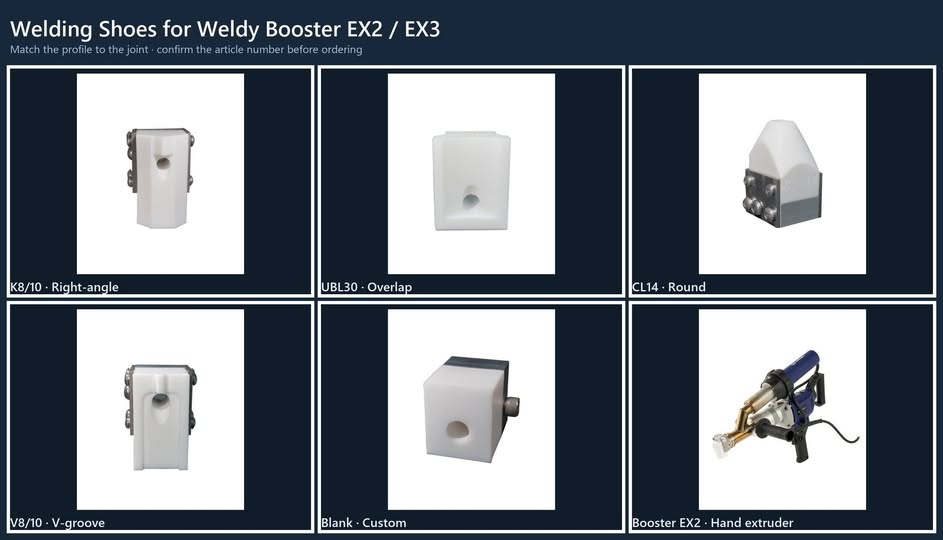

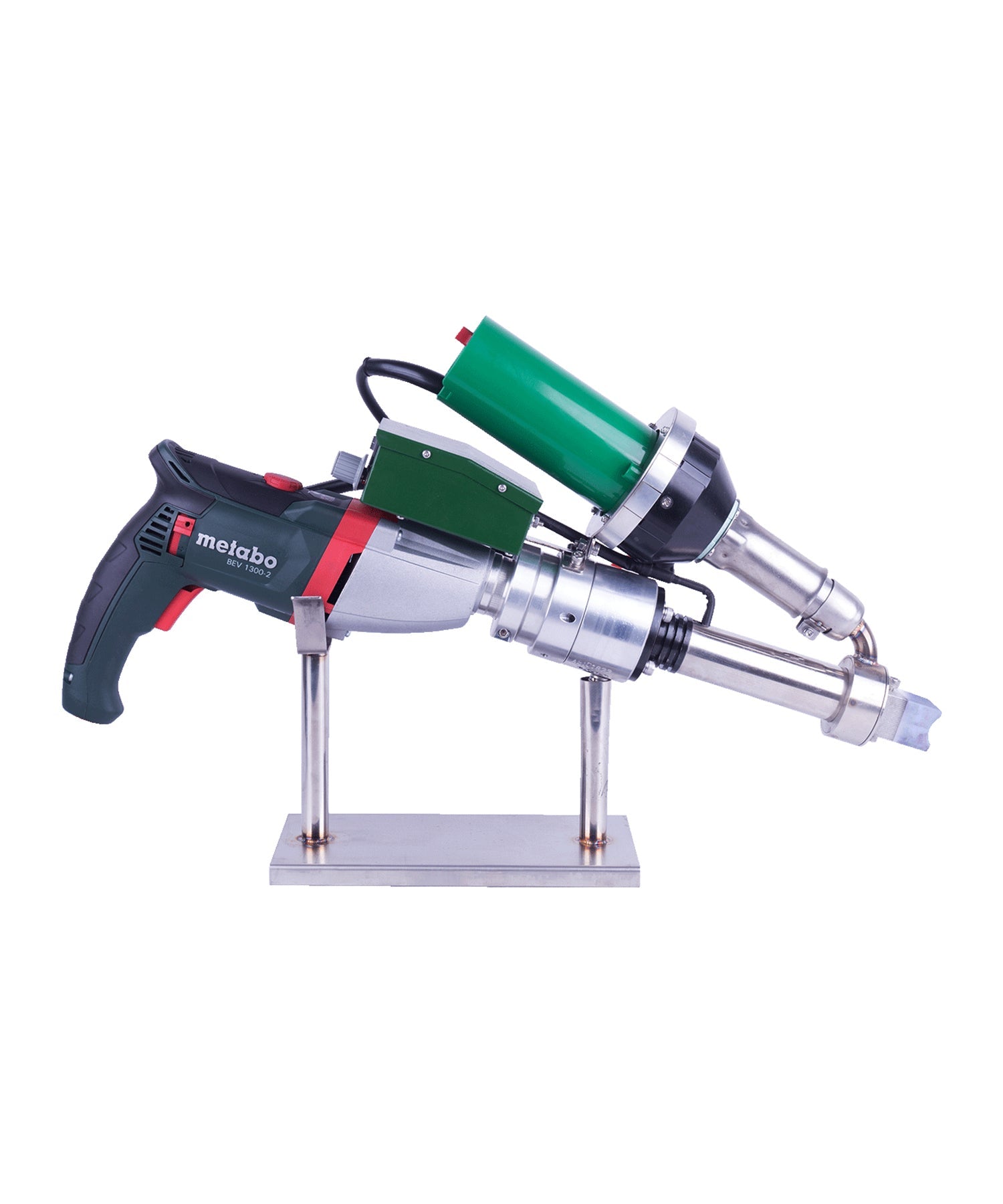
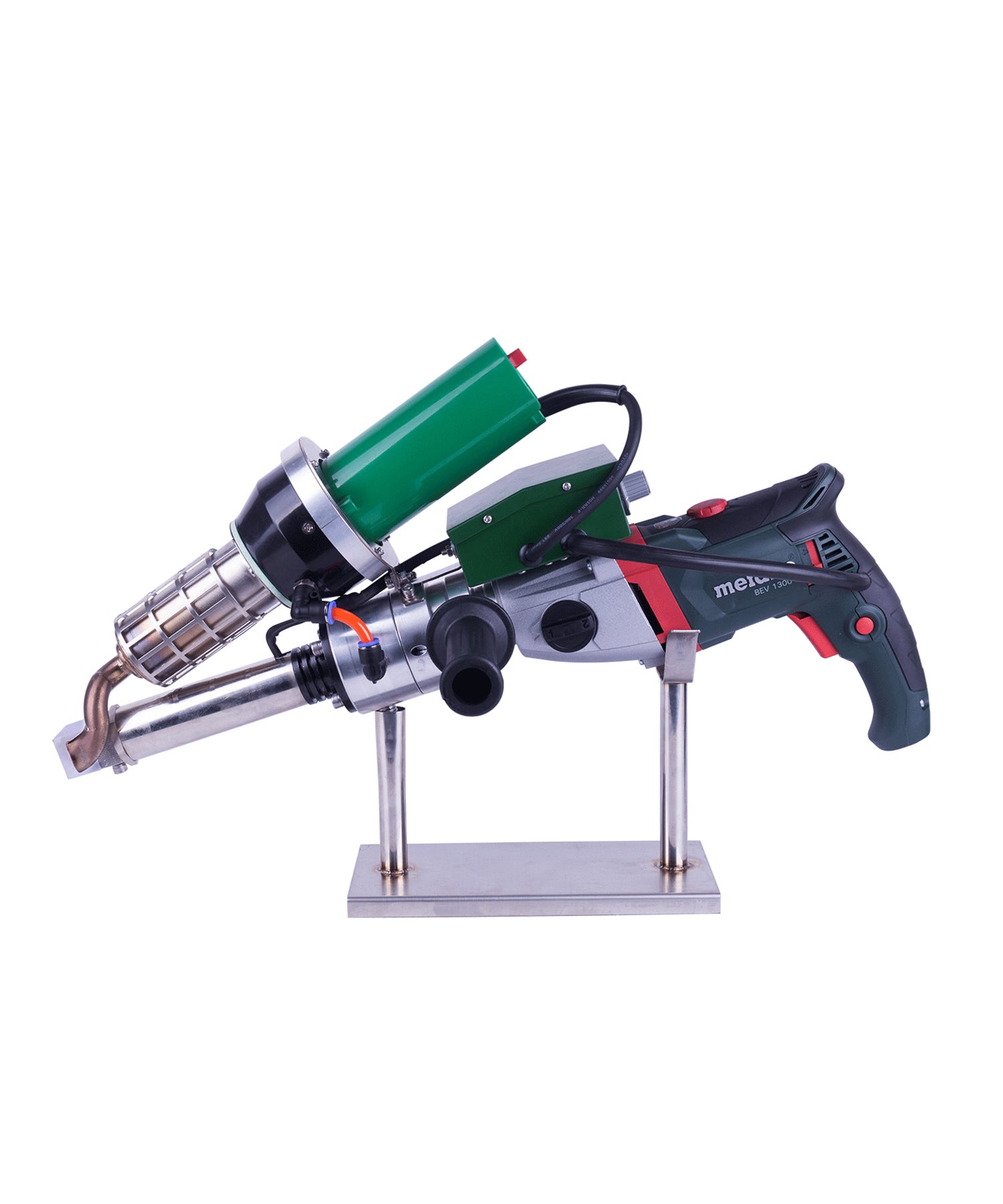
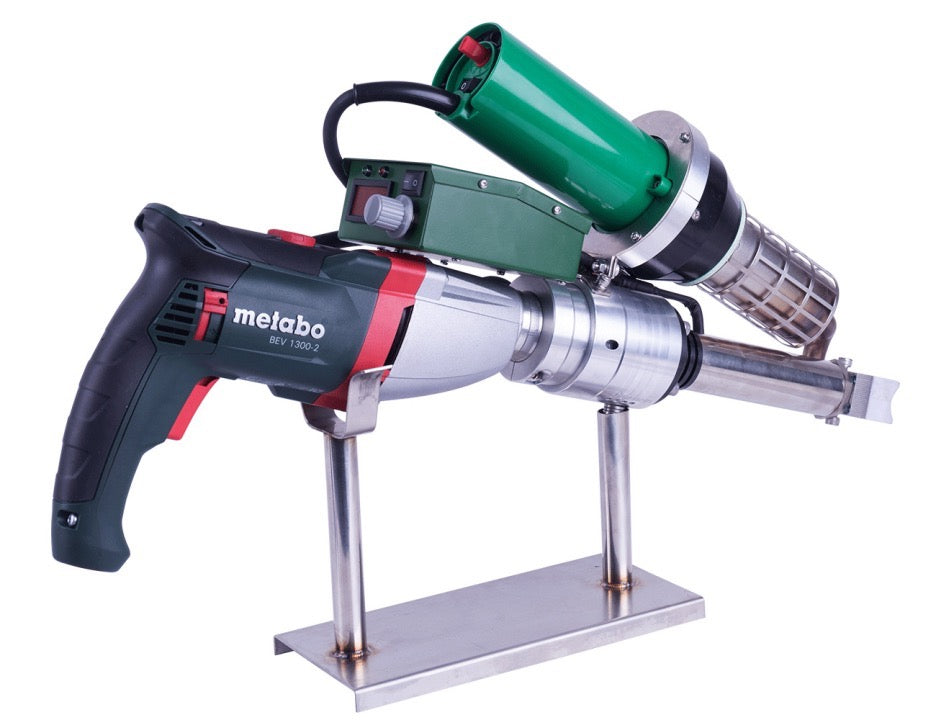
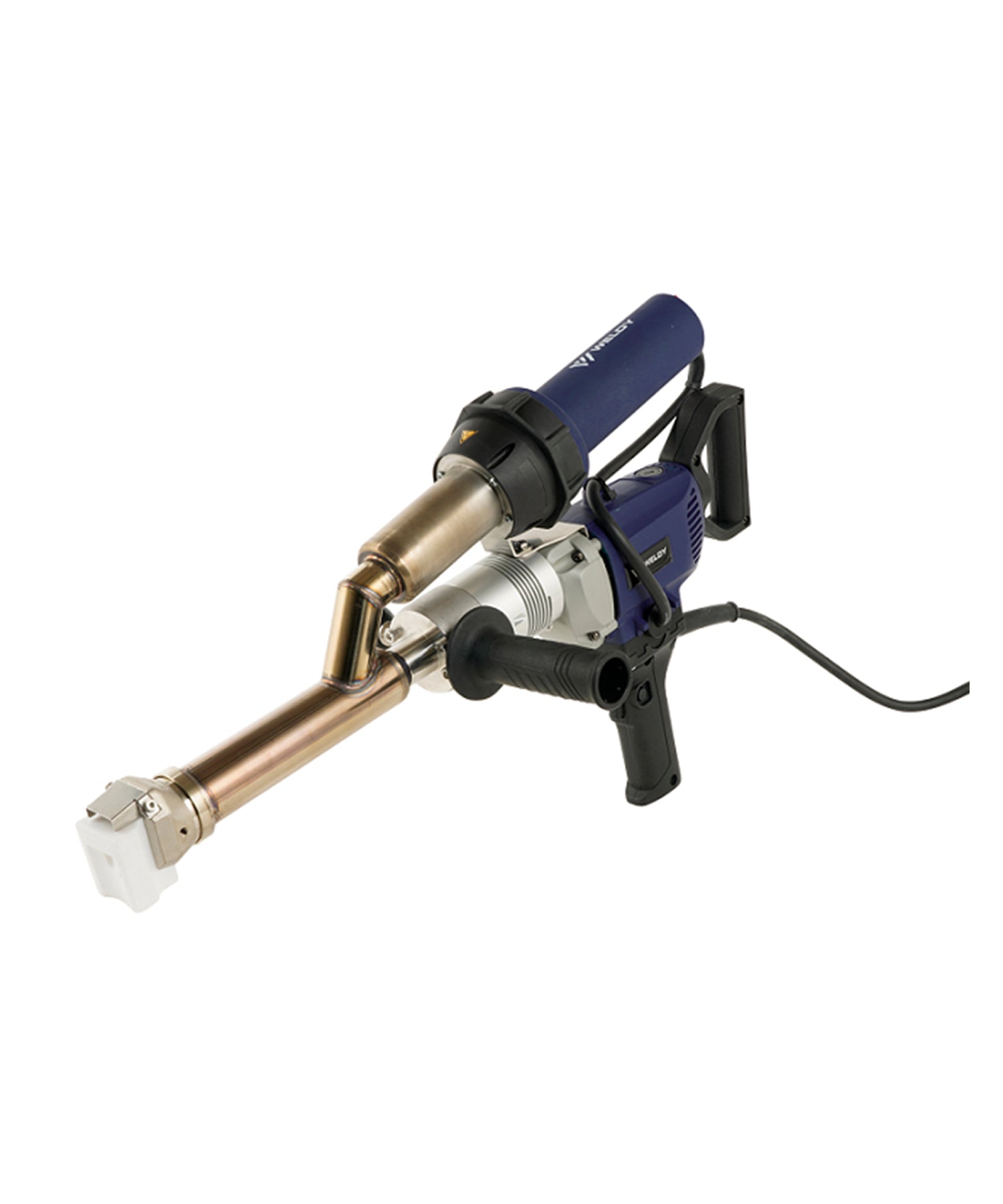
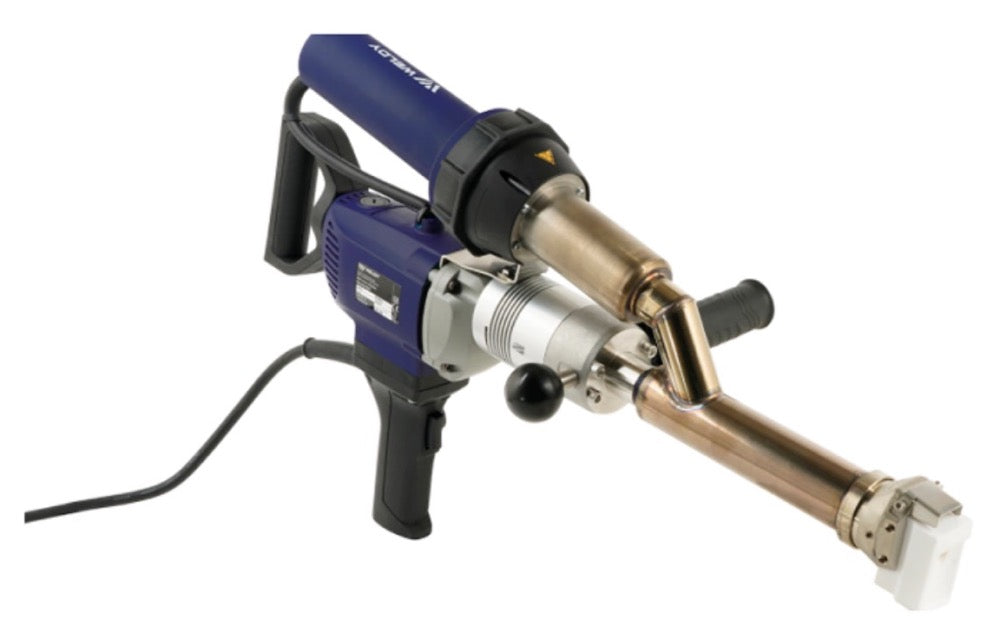
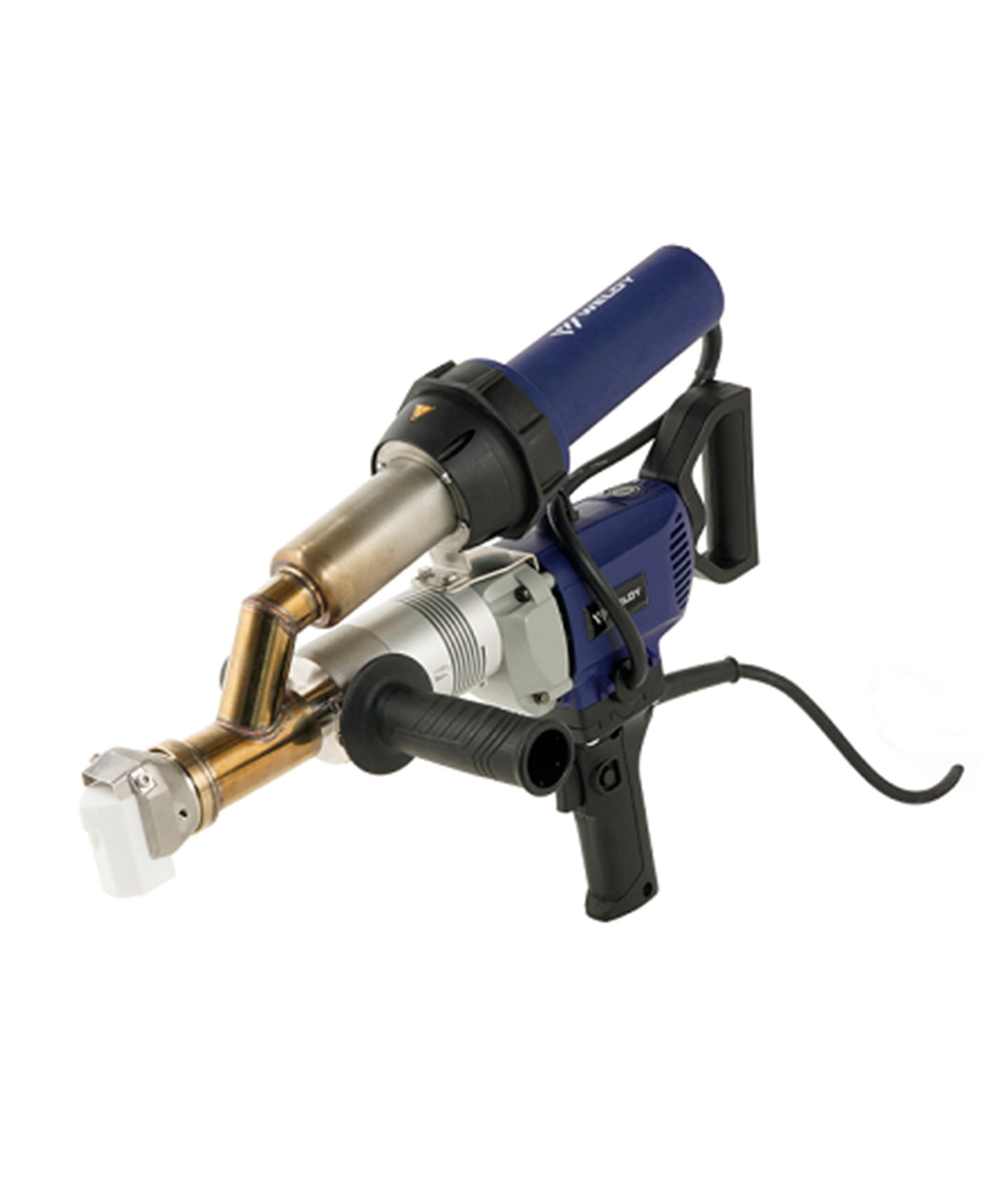
The welding shoe is fitted to the heater block of the Booster EX2/EX3 and shapes the weld profile as melt exits the nozzle.
Choosing a welding shoe for a hand extruder is not simply a matter of selecting a size. The shoe profile must match the joint geometry, and the exact Weldy article number must also match the extrusion welder.
For Booster EX2 and EX3 users, this distinction matters because similar shoe names can exist in different versions. A K8/10 shoe, for example, is available under more than one Weldy article number, and the listed machine compatibility is not identical. Always identify the exact part number before ordering.
Quick Answer: Which Welding Shoe Should You Choose?
Use the joint geometry as the starting point:
| Joint / Application | Common Shoe Profile | Typical Use |
|---|---|---|
| Corner or T-joint | K-type | Tanks, ducts, boxes and fabricated corners |
| Curved surface | CL-type | Pipes, cylindrical parts and curved structures |
| Overlap joint | UBL-type | Sheet overlaps, patches and liner details |
| Prepared V/X groove | V-type | Butt-joint and groove-welding applications |
| Non-standard geometry | Blank shoe | Custom-machined profile |
The profile tells you what shape you need. The Weldy article number tells you which exact accessory you are buying.
Weldy Welding Shoe Part Numbers and EX2/EX3 Compatibility
The table below uses current compatibility information published by Weldy.
| Weldy Shoe | Article No. | Booster EX2 | Booster EX3 |
|---|---|---|---|
| K8/10 | 126.105 | ✓ | ✓ |
| K15 | 126.106 | —* | ✓ |
| CO15 | 124.610 | ✓ | ✓ |
| CL14 | 124.611 | ✓ | ✓ |
| CS20 | 124.628 | ✓ | ✓ |
| V8/10 | 124.430 | ✓ | ✓ |
| V12 | 124.431 | ✓ | ✓ |
| V15 | 124.432 | ✓ | ✓ |
| UBL30 | 124.583 | ✓ | ✓ |
| Blank shoe insert, 50 × 30 × 38 mm | 126.104 | ✓ | ✓ |
*Weldy's current K15 126.106 product page lists Booster EX3 and EX3 Plus as compatible products, but does not currently list Booster EX2. Confirm compatibility before ordering for an EX2.
Weldy's official pages currently list K8/10 126.105, CL14 124.611, V8/10 124.430, V12 124.431, V15 124.432 and UBL30 124.583 among the welding-shoe insert range. Most of these are listed for both Booster EX2 and EX3.
K-Type Welding Shoes: For Corner and Fillet Joints
K-type shoes are one of the most useful profiles in plastic tank and equipment fabrication.
They are commonly selected for:
- 90° corner joints
- T-joints
- tank walls and bases
- rectangular ducts
- reinforcing structures
For EX2 and EX3 users, K8/10 article 126.105 is an important standard option and is currently listed by Weldy for both machines.
However, do not order a K8/10 shoe by name alone.
Weldy also lists K8/10 article 126.116, an Internal Air version. Its current compatible-product list includes Booster EX3 and EX3 Plus rather than EX2.
This is a good example of why the exact article number matters more than the profile name alone.

K-type right-angle shoes are the workhorse for corner and T-joints in HDPE chemical tank fabrication.
CL-Type Welding Shoes: For Curved Surfaces
A round or curved profile is useful when the welding path does not follow a straight corner.
The Weldy CL14, article 124.611, is currently listed as compatible with both Booster EX2 and Booster EX3.
Typical applications may include:
- pipe-related fabrication
- cylindrical tanks
- drums
- curved plastic components
- other joints where a straight fillet profile is not suitable
When working on a curved part, select the shoe according to the actual joint geometry rather than relying only on sheet thickness.
UBL-Type Welding Shoes: For Overlap Joints
Overlap profiles are intended for applications where one thermoplastic surface overlaps another.
The Weldy UBL30, article 124.583, is currently listed for Booster EX2, Booster EX3 and Booster EX3 Plus.
Typical uses include:
- sheet overlap seams
- local patches
- liner details
- repair areas
- flat overlapping components
For production work, make sure the shoe width and seam geometry correspond to the fabrication drawing or welding procedure.
V-Type Welding Shoes: For Prepared Groove Joints
Weldy currently lists several V-profile welding-shoe inserts:
- V8/10 — 124.430
- V12 — 124.431
- V15 — 124.432
These are currently listed by Weldy as compatible with Booster EX2 and EX3.
V-type profiles are used where the joint has been prepared with a corresponding V- or X-groove geometry.
Do not select a V8/10, V12 or V15 simply by assuming that the number equals the sheet thickness. The welding shoe should be selected according to the prepared joint geometry, welding procedure and required weld profile.
Blank Welding Shoes: When a Standard Profile Does Not Fit
Standard shoes cover many common fabrication jobs, but custom plastic structures do not always use standard joints.
Weldy currently lists a blank welding-shoe insert, article 126.104, for Booster EX2 and EX3. This provides a starting point when a workshop needs to machine a shoe to a specific geometry.
Weldy also lists an Internal Air blank welding shoe, article 126.100, which is currently shown as compatible with EX2, EX3 and EX3 Plus.
Blank shoes are useful for:
- unusual corner angles
- special tank geometries
- custom fabrication fixtures
- proprietary production joints
- workshops that machine their own welding tooling
Before machining a blank shoe, confirm that the selected base part matches the air-guide and mounting configuration of the extruder.
Welding Shoe Insert vs. Internal Air Welding Shoe
This distinction is easy to miss when shopping by product name.
Weldy's accessory range includes both welding-shoe inserts and Internal Air welding shoes. They can have similar profile names but different article numbers and compatibility.
For example:
| Product | Article No. | Current Weldy Compatibility |
|---|---|---|
| K8/10 welding-shoe insert | 126.105 | EX2 / EX3 / EX3 Plus |
| K8/10 Internal Air welding shoe | 126.116 | EX3 / EX3 Plus |
For this reason, ordering only by “K8/10” can lead to the wrong part.
Before ordering, confirm:
- Your exact extrusion-welder model.
- The existing shoe or accessory configuration.
- The Weldy article number.
- The required weld profile.
- Whether the part is an insert or a complete Internal Air shoe.
How to Choose the Correct Welding Shoe in 4 Steps
1. Start with the joint geometry
Identify whether you are welding a corner, T-joint, curved part, overlap or prepared groove.
2. Choose the corresponding profile
K, CL, UBL and V profiles serve different joint geometries. A blank shoe is the better starting point when no standard profile matches the fabrication drawing.
3. Check the machine model
Do not assume that every welding shoe listed for the Booster family fits both EX2 and EX3.
The current K15 126.106 and K8/10 Internal Air 126.116 listings demonstrate why model-specific checking is necessary.
4. Confirm the exact article number
This is the final step before purchasing.
If the profile name, machine model and article number all match, the risk of ordering the wrong accessory is much lower.
Do EX2 and EX3 Use the Same Welding Shoes?
Many welding-shoe inserts are listed for both machines, but not every Weldy welding shoe is universally interchangeable between EX2 and EX3.
For example, K8/10 article 126.105 is currently listed for both models, while K15 article 126.106 is currently listed for EX3 and EX3 Plus.
This is why a compatibility table is more useful than simply saying “EX2 and EX3 use the same shoes.”
For a full comparison of the two extrusion welders themselves, see our Weldy Booster EX2 vs EX3 Buying Guide.
Basic Care for Welding Shoes
Welding shoes should be kept clean and inspected for obvious wear, deformation or damage that could change the weld profile.
A few practical rules are enough:
- Keep the shoe and extrusion outlet free from accumulated polymer residue.
- Inspect the working profile for damage or excessive wear.
- Avoid damaging the shoe surface with unsuitable tools.
- Follow the applicable Weldy operating and maintenance instructions when installing or servicing accessories.
The purpose of this article is shoe selection and compatibility; welding parameters and weld-quality procedures should follow the relevant machine instructions and fabrication specification.
FAQ
Which welding shoe is best for tank corners?
K-type profiles are commonly used for corner and T-joints. K8/10 article 126.105 is currently listed by Weldy for Booster EX2 and EX3.
Is K15 compatible with Booster EX2?
Weldy's current product page for K15 article 126.106 lists Booster EX3 and EX3 Plus. EX2 is not currently shown in the compatible-product list, so compatibility should be confirmed before ordering it for an EX2.
Are all K8/10 welding shoes the same?
No. Weldy currently lists K8/10 article 126.105 as a welding-shoe insert and K8/10 article 126.116 as an Internal Air welding shoe. Their listed machine compatibility is also different.
Which welding shoes fit both EX2 and EX3?
Current Weldy listings include K8/10 126.105, CL14 124.611, CS20 124.628, V8/10 124.430, V12 124.431, V15 124.432 and UBL30 124.583 among the options listed for both machines.
Can I machine my own welding shoe?
A blank welding shoe can be used as the starting point for a custom profile. Weldy currently lists blank options including article 126.104 and Internal Air blank article 126.100. Confirm the correct base part and machine compatibility before machining.
Find the Right Welding Shoe for Your EX2 or EX3
The safest way to choose a welding shoe is not to start with price or even with the profile name.
Start with:
Joint geometry → shoe profile → machine model → exact article number.
If you already know your Booster model but are unsure which shoe fits your joint, compare the available welding shoes and extrusion-welding accessories in the Weissenberg Store Accessories collection.
For machine selection rather than accessory selection, read our Booster EX2 vs EX3 Buying Guide.
If you are still unsure, send us your extrusion-welder model, the existing part number and a photo or drawing of the joint. Our technical team can help you narrow down the correct profile before ordering.




Leave a comment
This site is protected by hCaptcha and the hCaptcha Privacy Policy and Terms of Service apply.