
1. Introduction: Why Hot Air Guns Matter in Plastic Welding
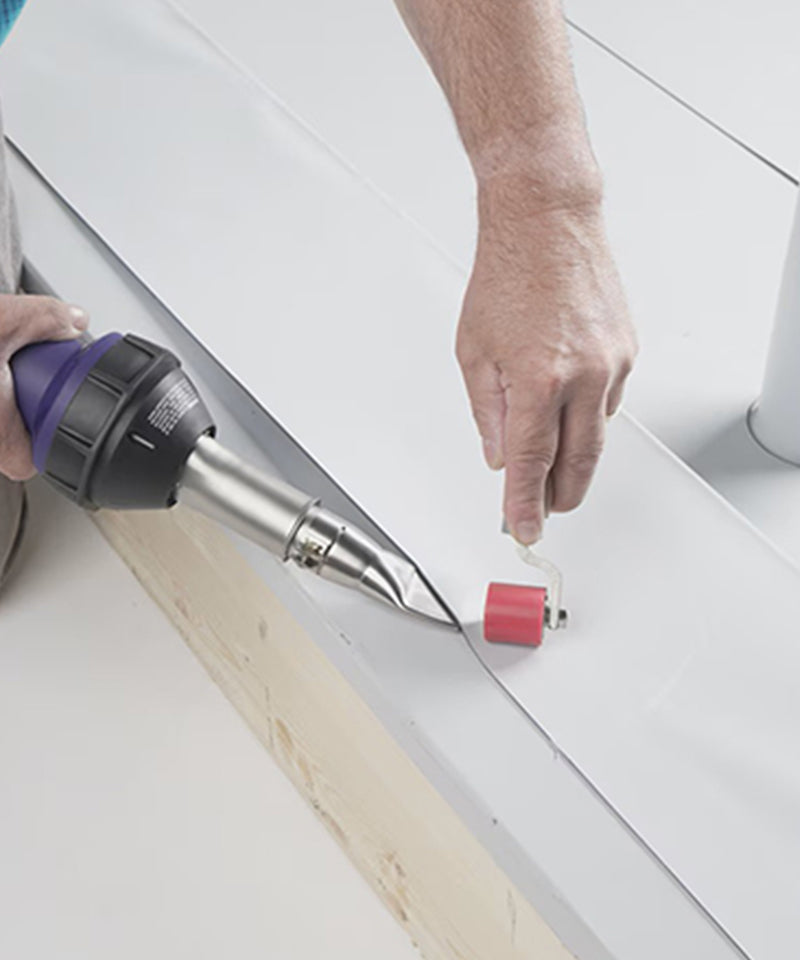
Hot air guns are the most versatile tools in any plastic welding workflow. From roofing membrane overlap welding to tarpaulin repair, geomembrane patching, and automotive plastic work, a quality hot air gun delivers consistent, reliable seams across a wide range of thermoplastic materials. Weldy’s Energy series—the HT1600 and HT3400—represents the gold standard in portable hot air welding, combining Swiss engineering from the Leister Group with practical, job-site-ready design. This guide provides an in-depth technical comparison of both models, helping you select the right tool for your specific application.
2. At a Glance: HT1600 vs HT3400
| Parameter | Weldy Energy HT1600 | Weldy Energy HT3400 |
|---|---|---|
| Power | 1,600 W | 3,400 W |
| Temperature Range | 40–700 °C (104–1,292 °F) | 40–700 °C (104–1,292 °F) |
| Airflow (20°C) | 240 l/min | 500 l/min |
| Static Pressure | 2,600 Pa | 3,500 Pa |
| Weight | 0.99 kg (2.2 lbs) | 1.2 kg (2.6 lbs) |
| Noise Level | 67 dB(A) | 68 dB(A) |
| Nozzle Connection | ø 31.5 mm | ø 50 mm |
| Heating Element | Ceramic | Ceramic |
| Motor Type | Robust brush motor | Robust brush motor |
| Temperature Control | Stepless, 40–700°C | Stepless, 40–700°C |
| Approvals | CE, KC, Protection Class II | CE, Protection Class II |
3. Weldy Energy HT1600: Precision in a Lightweight Package
The Energy HT1600 is designed for professionals who need a compact, lightweight hot air gun for precision welding tasks. At just 0.99 kg, it is one of the lightest professional-grade hot air guns on the market, making it ideal for overhead work and extended use without operator fatigue.
Key strengths:
- Ultra-lightweight design (0.99 kg) — Reduces wrist strain during long welding sessions and enables comfortable overhead operation for roofing membrane overlap welding
- Stepless temperature control (40–700°C) — Allows fine adjustment for different thermoplastics: PE/PP at 300–400°C, PVC at 400–450°C, TPO at 350–450°C
- Ceramic heating element — Provides consistent heat output with rapid warm-up and extended service life compared to mica-based elements
- Easy-clean air filter — Protects the motor from dust ingress on job sites, extending motor life significantly
- Heating tube protection — Prevents accidental contact burns and protects the heating tube during transport
- 240 l/min airflow with 2,600 Pa static pressure — Sufficient for standard overlap welding of membranes up to 2 mm thickness
4. Weldy Energy HT3400: High-Output Performance for Heavy-Duty Work
The Energy HT3400 delivers more than double the power and airflow of the HT1600, making it the go-to choice for large-surface overlap welding, continuous production environments, and heavy-gauge thermoplastic applications.
Key strengths:
- 3,400 W power output — Nearly double the HT1600, delivering enough heat for high-speed welding of wide membranes and thick materials
- 500 l/min airflow at 3,500 Pa — Generates a powerful, focused hot air stream that maintains temperature across the full width of wide-slot nozzles (up to 70 mm)
- Weight-optimized at 1.2 kg — Despite the significantly higher power, the HT3400 weighs only 0.2 kg more than the HT1600, maintaining excellent ergonomics
- Stepless temperature control (40–700°C) — Same wide range as the HT1600, ensuring material compatibility across PE, PP, PVC, TPO, and PVDF
- Dust filter protection — Enhanced filtration for demanding outdoor job site conditions
- Ceramic heating element + brush motor — Proven reliability for high-duty-cycle operation
5. Choosing Between HT1600 and HT3400: Application-Based Selection
Selecting the right model depends on the specific demands of your project:
| Use Case | Recommended Model | Why |
|---|---|---|
| Overhead roofing membrane welding | HT1600 | Under 1 kg, easy to manage above shoulder height |
| Large-format PVC tarpaulin seams | HT3400 | High airflow maintains temperature across wide overlap seams |
| Geomembrane patch repair (confined space) | HT1600 | Compact size for tight access areas |
| Continuous production-line welding | HT3400 | High duty cycle and sustained heat output |
| Automotive plastic bumper repair | HT1600 | Precision control for detailed work |
| Billboard and banner fabrication | HT3400 | Fast, uniform heating of large surface areas |
6. Accessories for Maximum Versatility
Both the HT1600 and HT3400 are compatible with a wide range of Weldy/Leister accessories that dramatically expand their capabilities:
- Quick-welding nozzles (4 mm, 5 mm) — For precision overlap welding of narrow seams in tarpaulin and banner fabrication
- Wide-slot nozzles (20 mm, 40 mm, 70 mm) — For broad overlap welding of roofing membranes and geomembranes; the 70 mm nozzle is particularly effective with the HT3400’s high airflow
- Reflector nozzles — For pipe shrinking, cable end caps, and heat-shrink applications
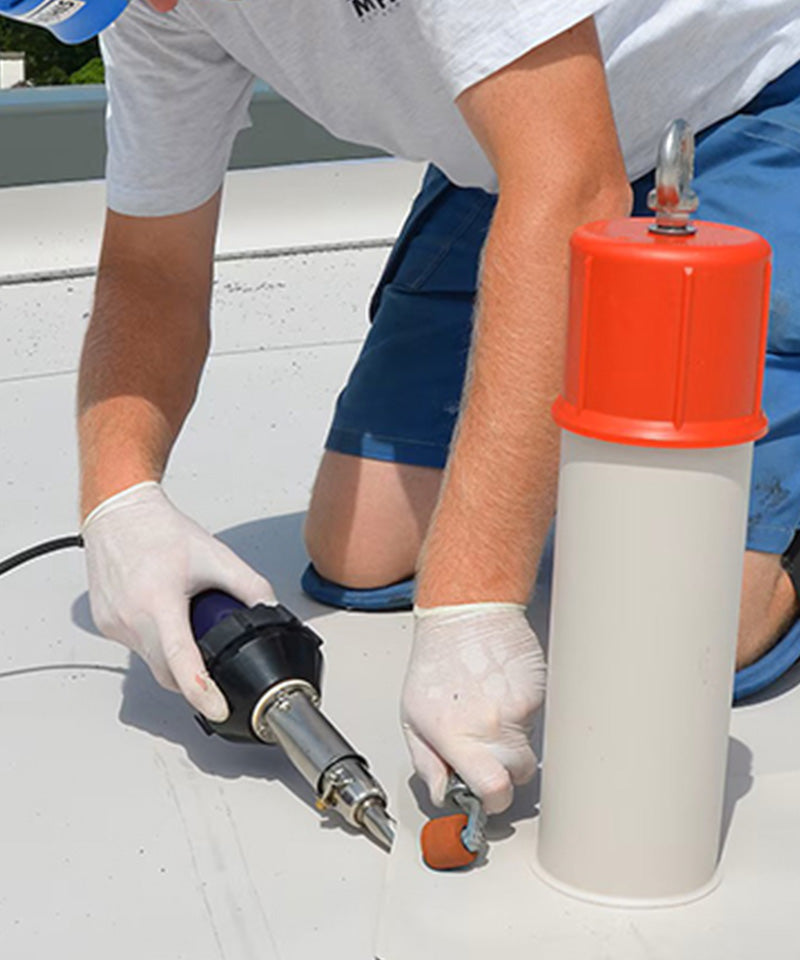
- Silicone pressure rollers — Apply consistent pressure behind the hot air stream to ensure molecular bonding at the weld interface
- Speed-welding nozzle sets — Combine welding nozzle and pressure roller in one assembly for one-pass overlap welding
- Electric drill attachment — Converts the HT1600/HT3400 into a semi-automated welding tool for repetitive long-seam applications
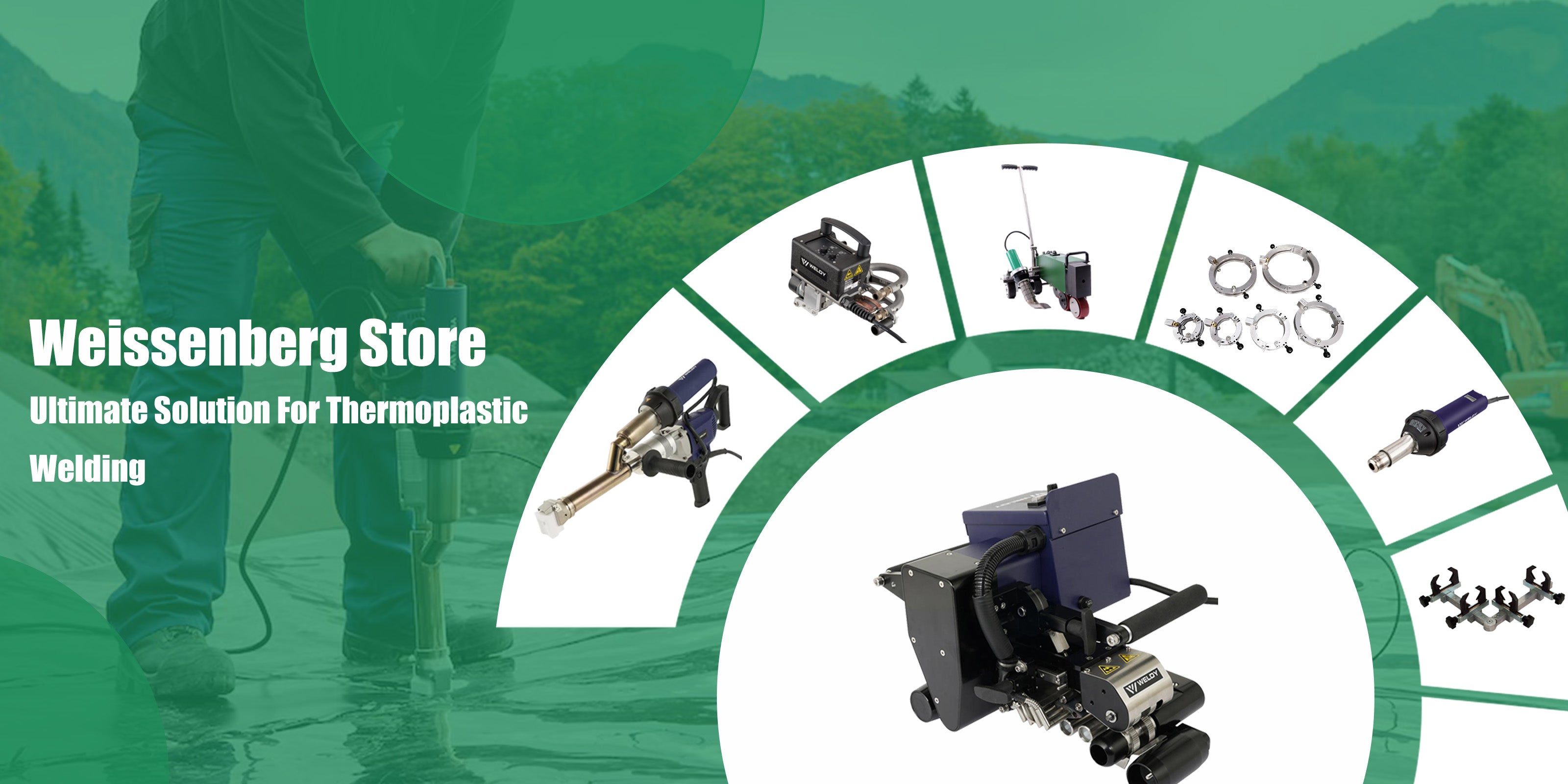
Explore the full range of accessories at Weissenberg Store.
7. Best Practices for Hot Air Gun Welding
To achieve consistent, high-quality welds with your Weldy Energy hot air gun, follow these field-tested guidelines:
- Surface preparation — Clean and dry all welding surfaces. Contaminants (dust, oil, moisture) reduce seam strength by up to 50%.
- Temperature calibration — Verify actual nozzle temperature with a contact pyrometer before each shift. ASTM D6392 requires accuracy within ±5°C for critical seams.
- Material-specific settings — HDPE/LLDPE: 350–400°C, PVC: 400–450°C, TPO: 350–450°C, PP: 300–350°C. Always run test strips before production.
- Welding speed — Maintain consistent travel speed. For overlap welding with the HT1600 and a 20 mm nozzle, a speed of 0.5–1.0 m/min produces optimal results.
- Pressure application — Use a silicone pressure roller immediately behind the hot air stream. Apply firm, even pressure to ensure molecular diffusion at the weld interface.
- Cool-down — Allow welded seams to cool naturally under pressure for at least 30 seconds before moving or stressing the joint.
8. Maintenance and Care
Regular maintenance extends the life of your Weldy Energy hot air gun and ensures consistent performance:
- After each use — Clean the air filter with compressed air; wipe the nozzle housing clean of residue
- Weekly — Inspect carbon brushes; replace when worn to 6 mm or less. Standard Weldy carbon brush sets (part no. 125.810) are available from Weissenberg
- Monthly — Check the heating element for signs of oxidation or damage; verify temperature calibration
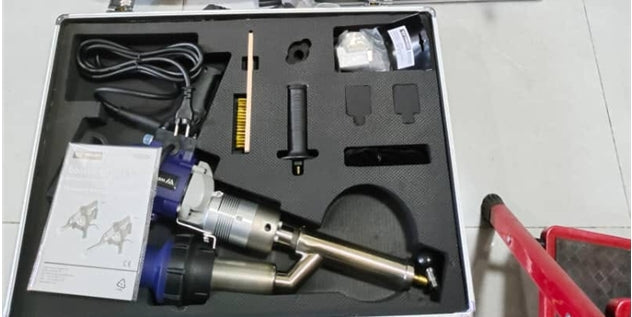
- Storage — Store in the original case in a dry environment at 5–35°C. Never wrap the power cord tightly around the tool, as this can damage internal wiring
- Brushless motor note — The HT1600 and HT3400 use brush motors; expect to replace carbon brushes every 500–1,000 operating hours depending on dust conditions
9. Why Buy from Weissenberg, an Official Weldy Distributor
When you purchase your Weldy Energy HT1600 or HT3400 from Weissenberg, you receive more than just a tool:
- 100% Genuine Weldy Products — Full manufacturer warranty with factory traceability, CE certification, and ISO 9001 compliance
- Competitive Pricing — Long-term partnership with Weldy/Leister ensures attractive pricing on all models
- Year-Round Stock — Both HT1600 and HT3400 models held in stock in multiple voltage variants (230V, 120V)
- Kit Options Available — Choose from standard tools or complete kits (Plastic Kit, Overlap Kit, Shrink Kit) with nozzles, rollers, and case included
- Technical Support — Application guidance, troubleshooting, and after-sales service in multiple languages
- Fast Shipping — 48-hour domestic shipping, 72-hour international shipping on in-stock items
Visit Weldy Energy HT1600 or Weldy Energy HT3400 to place your order, or browse the full Weldy range at Weissenberg Store.
Author: Weissenberg Technical Team — 19+ Years of Thermoplastic Welding Expertise




Leave a comment
This site is protected by hCaptcha and the hCaptcha Privacy Policy and Terms of Service apply.