
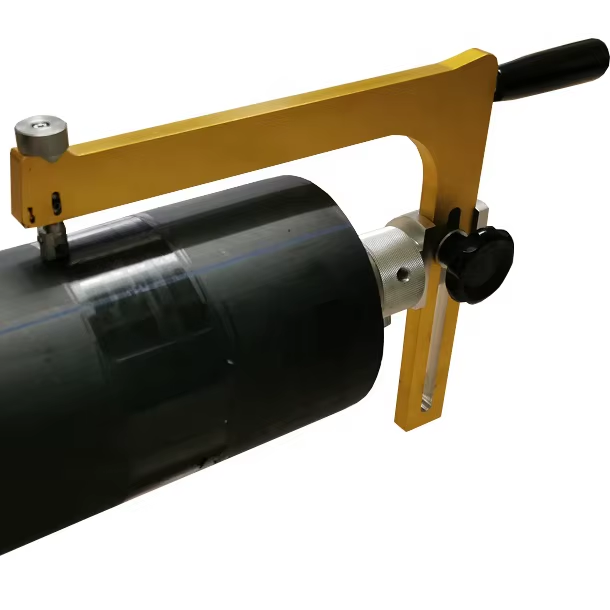
Electrofusion forgives a lot — but not an oxidized pipe surface. Before every coupling, saddle or repair fitting goes on, the weld zone must be scraped back to bright virgin material, and the tool your crew carries decides how fast, how uniform and how repeatable that scrape is. Weissenberg builds two scraper families for this job: the HAWK rotary scrapers and the GOPHER uniprep scrapers. This guide compares them range by range.
Why Scraping Depth Decides Joint Quality
Polyethylene develops a thin oxidized layer on its surface during extrusion and during UV exposure in storage. Left in place, this layer inhibits molecular diffusion across the fusion interface, so the joint never develops the strength the fitting is rated for. Guidance from the Plastics Pipe Institute (PPI) on electrofusion preparation calls for removing at least 0.18 mm (0.007 in) of the outer pipe surface to expose clean virgin material, while the applicable joining procedure or fitting manufacturer’s instructions govern where they are more specific. Abrasives such as sandpaper or emery cloth are never acceptable: they leave particles embedded in the surface instead of peeling off a clean, uniform layer.
The Scraping Rules That Travel With Every Crew
- Depth: remove the oxidized surface layer; PPI guidance specifies at least 0.18 mm (0.007 in), while fitting-manufacturer requirements take precedence where specified.
- Witness test: mark the weld zone with a permanent marker before scraping; after scraping, no trace of ink should remain. Leftover ink means the oxidized layer is still there.
- Full coverage: scrape the complete insertion length of the fitting socket, not just a strip — oxidized material anywhere in the weld zone becomes a weak path.
- Cleanliness and timing: clean the freshly scraped surface and weld within the interval the fitting manufacturer or applicable procedure specifies; do not touch the prepared zone.
- Never scrape inside an electrofusion fitting — the fitting bore is manufactured to precise geometry and must be left as delivered.
HAWK Rotary Scrapers: One-Pass Socket Preparation

The HAWK series is built around an adjustable chuck that locks onto the pipe and a blade holder that peels material at a consistent depth around the full circumference. It scrapes the entire socket length of the electrofusion sleeve in one pass — the combination of repeatability and speed that matters most on straight, clampable pipe, whether in the workshop or on a new build. The chuck-and-orbital-arm design is intended to support consistent material removal around the pipe circumference, reducing reliance on freehand scraping technique.
| Model | Working Range | Scraping Length | Best For |
|---|---|---|---|
| HAWK 200 | Ø75–200 mm | 129 mm | Distribution mains, service lines, shop fabrication |
| HAWK 400 | Ø160–400 mm | 150 mm | Large-diameter mains and repair sleeves |
GOPHER Uniprep Scrapers: Repair-Pit Ready

The GOPHER uniprep design takes a different route to the same controlled cut. A hardened blade in the uniprep head removes a predictable depth of material while the tool follows the pipe freehand — exactly what repair work demands: out-of-round pipe cut from a live main, tight excavations, awkward saddle positions, pipe that cannot be clamped into a chuck. Coverage also extends below the HAWK range, down to Ø63 mm, which is why water utilities and repair crews keep one in every jointing kit.
| Model | Working Range | Scraping Length | Best For |
|---|---|---|---|
| GOPHER 250 | Ø63–250 mm | 130 mm | Service lines, repairs, small-diameter saddles |
| GOPHER 315 | Ø63–315 mm | 170 mm | Long sockets and mid-size mains on repair duty |
View GOPHER 250 | View GOPHER 315
HAWK vs GOPHER: Which Scraper Fits Your Work
| HAWK 200 / 400 | GOPHER 250 / 315 | |
|---|---|---|
| Design | Chuck-mounted rotary scraper, orbital blade-holder design | Uniprep hand-guided scraper, hardened blade |
| Diameter coverage | Ø75–400 mm | Ø63–315 mm |
| Socket length in one pass | 129–150 mm | 130–170 mm |
| Shines on | Straight, clampable pipe; new builds and fabrication; repeated sockets at the same tolerance | Repair pits, out-of-round or awkward pipe, saddles, small diameters, tight access |
| Typical owner | Fabrication shops, pipeline contractors on new lay | Water utilities, gas repair crews, maintenance teams |
A crew that mostly fuses new mains will standardize on HAWK and hit the stated tolerance socket after socket; a crew whose week is repairs will standardize on GOPHER because it follows whatever the pipe gives them. Contractors who do both carry one of each.
Related Reading: External Bead Removal After Butt Fusion
Scraping is the pre-weld story for electrofusion. If your crews also butt-fuse, the post-weld counterpart is removing the external roll-back bead. Note that ASTM F2620, the standard practice for heat fusion joining of polyethylene pipe, describes the fusion bead’s appearance as a visual indicator of joint quality — it does not itself mandate bead removal. Removal is a finishing step driven by project requirements: a flush outside surface for slip-lining into a host pipe, or a specified flush finish. For that step, the CONDOR 400 (Ø110–400 mm) and CONDOR 800 (Ø450–800 mm) external debeaders cut the bead flush without scoring the pipe wall, hot or cold. Our surface preparation overview covers the full line in one table.
Blade Care and Field Discipline
Whichever scraper you choose, the tool only holds tolerance while the blade is sharp. Replace blades at the first sign of skipping or tearing instead of a clean peel, and check removed shavings with a caliper now and then to confirm the depth has not drifted. Store the tool clean and dry, protect the blade from impact, and hold the crew to the full discipline — witness marks, full-socket coverage, no touching the prepared surface. The tool is half of a sound joint; the habit is the other half.
Both scraper families are manufactured in our own facility to the same quality standard Weissenberg applies across its welding range, and every tool ships with a one-year warranty and lifetime technical support. If you are unsure which scraper matches your pipe sizes and site conditions, weissenbergstore.com lists the full selection — or ask our online team to build a jointing kit around your project.
Author: Weissenberg Technical Team — 19+ years in plastic welding equipment. Standards and guidance referenced: ASTM F2620, DVS 2207-1, PPI electrofusion preparation guidance.
Tags: HDPE pipe scraper, electrofusion preparation, rotary scraper, uniprep scraper, HAWK, GOPHER, scraping depth, PE pipe welding




Leave a comment
This site is protected by hCaptcha and the hCaptcha Privacy Policy and Terms of Service apply.