
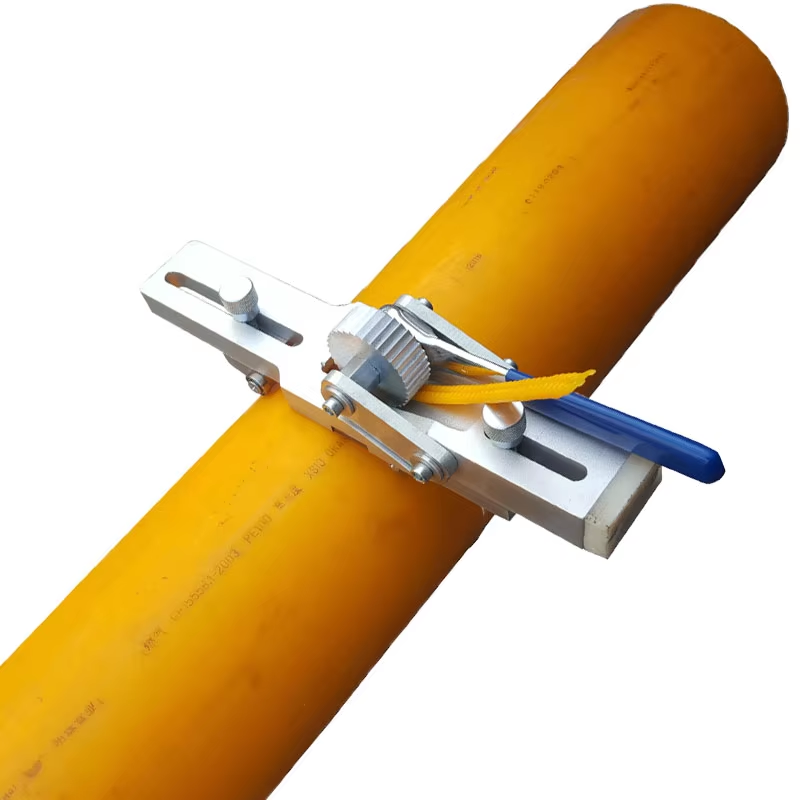
Every HDPE joint — butt-fused, electrofusion-welded or hand-welded — inherits its strength from the work done before the heat is applied. An oxidized pipe surface or a rough weld bead can quietly shorten joint life. Weissenberg’s surface preparation line — the CONDOR external debeaders, the HAWK rotary scrapers and the GOPHER uniprep scrapers — is engineered so joints come out clean, inspectable and ready to weld.
Why Surface Preparation Determines Weld Quality
Polyethylene develops a thin oxidized layer during extrusion and UV exposure in storage. Left in place, this layer inhibits molecular diffusion across the fusion interface, producing weak, leak-prone joints. Industry practice calls for the weld zone to be mechanically scraped to a uniform depth of roughly 0.2–0.3 mm, exposing bright virgin material — many electrofusion failures trace back to inadequate scraping. DVS 2207-1 provides procedural guidance for these preparation steps.
The Weissenberg Surface Preparation Line at a Glance
Three tool families cover two distinct jobs: post-weld bead removal from butt-fusion joints (CONDOR) and pre-weld surface scraping before electrofusion (HAWK, mechanical; GOPHER, manual).
| Tool | Job | Working Range | Key Spec | Weight |
|---|---|---|---|---|
| CONDOR 400 | Post-weld bead removal | 110–400 mm | 365×102×105 mm | 3.0 kg |
| CONDOR 800 | Post-weld bead removal | 450–800 mm | 410×123×140 mm | 5.5 kg |
| HAWK 200 | Pre-weld rotary scraping | 75–200 mm | Scrape length 129 mm | — |
| HAWK 400 | Pre-weld rotary scraping | 160–400 mm | Scrape length 150 mm | — |
| GOPHER 250 | Pre-weld manual scraping | 63–250 mm | Scrape length 130 mm | — |
| GOPHER 315 | Pre-weld manual scraping | 63–315 mm | Scrape length 170 mm | — |
Post-Weld Bead Removal: CONDOR 400 & 800
Butt fusion forms a weld bead on both sides of the joint. The external bead is not needed for strength, and removing it becomes necessary when the specification calls for a flush finish, when the pipe must be slip-lined into an existing host, or when a twist-back inspection is required. A flush surface also lets inspectors read the bead geometry — a key non-destructive indicator of fusion quality.
The CONDOR knocks onto the bead; alignment blocks slide on the pipe surface to guide the tool around, and the blade cuts under the bead without damaging the wall. The CONDOR 400 covers 110–400 mm pipes; the CONDOR 800 extends the same operation to 450–800 mm, working hot or cold. Both also trim flat, butt-welded plastic sheets once the pipe guides are removed.

Pre-Weld Surface Scraping: HAWK & GOPHER
HAWK 200 & 400 — Mechanical Rotary Scrapers
Electrofusion demands a scraped insertion area over the full coupling length, at controlled depth. The HAWK rotary scrapers are purpose-built: an adjustable chuck adapts to a range of pipe diameters, and a blade holder on an orbital arm removes material evenly — 129 mm of scraped surface per pass on the HAWK 200 (75–200 mm pipes), 150 mm on the HAWK 400 (160–400 mm). Uniform travel helps prevent the skipped patches that can compromise fusion quality, making HAWK suitable for crews re-fusing damaged sections.

GOPHER 250 & 315 — Manual Uniprep Scrapers
Where a mechanical scraper is impractical — tight trenches, irregular pipe, occasional work — the GOPHER uniprep scrapers deliver manual rotary scraping with a hardened blade and a controlled depth of cut. Rotated smoothly around the pipe, the GOPHER 250 serves 63–250 mm diameters and the GOPHER 315 extends to 315 mm (scrape lengths 130 mm and 170 mm). Lightweight and low-maintenance, they suit small contractors, repair crews and field back-up.

How to Choose the Right Tool
| Your Job | Pipe Range | Recommended Tool |
|---|---|---|
| Post-weld external bead removal | 110–400 mm | CONDOR 400 |
| Post-weld external bead removal | 450–800 mm | CONDOR 800 |
| Pre-weld scraping — frequent jobs | 75–200 mm | HAWK 200 |
| Pre-weld scraping — frequent jobs | 160–400 mm | HAWK 400 |
| Pre-weld scraping — occasional / tight spaces | 63–315 mm | GOPHER 250 / 315 |
Rule of thumb: for crews with regular fusion work, a mechanical scraper can pay for itself in consistent joint quality; if prep is occasional or access is difficult, the manual GOPHER keeps the job controlled without extra equipment.
Field Best Practice — Scrape, Verify, Clean, Weld
- Mark the fusion zone (insertion depth plus a small allowance) with a permanent marker.
- Scrape mechanically until the full marked area is clean — aim for the 0.2–0.3 mm removal depth referenced in industry practice.
- Verify: all marker traces gone, surface bright and uniform — remaining marks indicate the oxidized layer is still present.
- Clean with an alcohol-based PE cleaner (of the type certified to DVGW VP 603), let it dry fully, and avoid touching the prepared area. If preparation and welding are delayed, consider re-scraping before proceeding.
Avoid using sandpaper, files or abrasive discs for preparation — they can embed contamination that may compromise fusion quality.
Maintenance That Keeps Joints Consistent
- Rotate or replace blades. Scraper blades are multi-sided: rotate to a fresh edge when dull, replace when nicked.
- Clean after every use. Blow off swarf with compressed air; apply light oil to the adjusting screw, away from the blade.
- Inspect before each job. Rollers, guides and springs should move freely.
- Periodic test. If the tool sees heavy seasonal use, run it on a spare pipe to confirm an even, complete ribbon of material removal.
Every Weissenberg tool carries a 1-year warranty and lifetime technical support.
Buyer FAQ
1. Do I need a debeader if my specification does not require bead removal?
If the pipe will be slip-lined, inspected via twist-back, or needs a flush surface for coating, bead removal is necessary regardless of the base spec. For exposed field joints where bead geometry is the only quality indicator, removing the bead makes visual inspection far easier. If none of these apply, the bead can typically be left in place.
2. Can I use the CONDOR on flat HDPE sheet welds, or is it pipe-only?
The CONDOR is designed for pipe butt-fusion joints, but once the pipe guides are removed, the blade also trims flat, butt-welded plastic sheets. For thin-gauge sheet welding, a hand scraper or rotary tool may be more appropriate — check the sheet thickness against the blade depth before use.
3. When does a mechanical HAWK scraper make sense over a manual GOPHER?
If your project involves frequent electrofusion work across multiple pipe sizes, the HAWK’s adjustable chuck and orbital blade deliver faster, more consistent scraping. For one-off repairs, tight trench access, or small-diameter occasional work, the GOPHER manual scraper is lighter, simpler, and equally effective when used carefully.
4. How often should scraper blades be replaced?
Blades are multi-sided — rotate to a fresh edge when the current edge feels dull or stops producing clean ribbons. Replace the blade entirely when edges are nicked, chipped, or all sides are exhausted. Sharp blades are the single biggest factor in achieving proper scraping depth; a dull blade tends to skid over the oxidized layer rather than removing it.
Why Buy Surface Prep Tools from Weissenberg
CONDOR, HAWK and GOPHER are manufactured by Weissenberg — backed by 20+ years of industry experience and lifetime technical support. You buy directly, with no middleman markup. Every tool carries a 1-year warranty and is built for field toughness. Browse the Plastic Welding Tools collection, or see the CONDOR 400, HAWK 200 and GOPHER 250 pages (larger models available in-store).
By the Weissenberg Technical Team — 20+ years in plastic welding technology.





Leave a comment
This site is protected by hCaptcha and the hCaptcha Privacy Policy and Terms of Service apply.